Sunday, 26 July 2015

Why My Son Was Baptised: Part 2

Having established the biblical and traditional foundations for affirming the efficacy of Baptism, we next explore the question of "what is it efficacious for"?

Starting again from scripture and examining the texts previously referenced in Part I, we find that a parallel is drawn between baptism and circumcision. Circumcision, an act initiating an individual into God's covenant community in the Old Testament, is aligned with the practice of baptism in the New Testament (Col 2: 11-12). Although the scriptures remain firm on the centrality of faith and obedience in bringing meaning to the act of circumcision (1 Cor 7: 19), they do not divorce inward faith from the external act. Utilizing this framework, we come to an understanding of baptism that underscores it's centrality in the Church's mission and life - that through this act God incorporates an individual into the greater body of Christ (1 Cor 12:13), God's new covenant community established in light of the death and resurrection of Jesus Christ. 

St. Athanasius, in his response to the Arian controversy, relied heavily on this understanding of baptism to defend the co-divinity of the Father, Son and Holy Spirit:
The faith in the Trinity transmitted to us is the only one, and it unites us with God, and whoever takes something away from the Trinity and baptizes in the name of the Father, or in the Son alone, or into the Father and the Son without the Spirit, receives nothing, but those being baptized and he imagines himself to be giving baptism remain in vanity and unconsecrated, because the Mystery is accomplished in the name of the Trinity: so that whoever separates the Son from the Father or reduces the Spirit to a creature has neither the Son nor the Father but is an atheist, worse than an unbeliever, and anything but a Christian.
Implicit within his argument is the assumption that the efficacy of baptism is driven by the power of the Trinitarian God, subsuming the individual into the divine life of the Trinity and hence into the Church as Christ's body. Thus, a failure to appropriately recognize the effector of this act leads to a baptism that is inefficacious for true Christian conversion, leaving nothing accomplished in the unseen realm and keeping the individual separate from true union with the body of Christ. 

This close relationship between a sacramental understanding of baptism and the Church may be readily observed today: in communities where a robust and well-developed eccelesiology is articulated, a  deeply sacramental understanding of baptism continues to be practiced (e.g. Anglicanism, Roman Catholicism, Lutheranism), with a recognition of the integral part it plays in Christian faith and practice. Likewise, Christian communities with a less established ecclesiology typically downplay the significance of baptism. As unfortunate as it is, this latter pattern has become pervasive in protestantism, driven by an individualism which has been characteristic of a post-modern worldview emphasizing individual belief and opinion against corporate confession and belief.

In summary, an examination of scripture as well as tradition suggests the following regarding baptism:
  1. Baptism is more than a "symbolic" act of an inward conversion. Rather, baptism performed in the context of faith, is an act demanded by God of the Church, in which He effects a change in the life of the recipient.
  2. The effect of baptism is tied closely to the believer's participation in the life of the Church; God has made it normative that all who come to faith are to be baptized into the body of Christ (However, normativity does not necessarily translate into exclusivity; someone who confesses faith in Christ and dies before being baptised will still be saved).

Tuesday, 21 July 2015

Why My Son Was Baptised: Part I


My son Benjamin was recently baptised on the 19th of July 2015 at Wesley Methodist Church; since then I have received a few queries on why I practice infant baptism. Having reflected on this very issue leading up to the decision to have him baptised, I decided it best to pen my thoughts down and crystallize them in prose.

Within that query, there are two separate questions which need to be addressed - the act itself (i.e. baptism) and the adjective that defines that act (i.e. infant).

Regarding baptism, the two sub-issues most pertinent to Protestants are "Is baptism just a symbol of belief, or is it efficacious in and of itself?" and "What is it efficacious for?"

Protestantism today often reduces baptism to an act of symbolism, in which a believer makes an outward declaration of a new-found faith. The act in this case is always secondary, being borne out of, but not influencing the inward rebirth of the believer being baptised. I would propose that this is not the case; that baptism has an efficacy in the inner life of the recipient of the sacrament, whilst remaining contingent on the necessity of faith (although this may not necessarily be the faith of the believer, as I shall discuss later).

Taking scripture as the starting point, we don't find much teaching about baptism per se; although the biblical authors repeatedly reference baptism throughout the New Testament, these references are indirect - i.e. there are no teachings on what baptism is, only assumptions on behalf of the reader on its significance and meaning. Nonetheless, we repeatedly find that baptism is associated with the death of old-self (Romans 6:4), has regenerative connotations (Colossians 2:12), is fundamental in the mission of the Church (Matt 28:19), and is considered a normative practice of the Christian faith (Acts 2:38). The use of baptism in these scriptures suggests that it is more than a optional act symbolic of inward faith; rather it points to a deeper reality that make it a core part of Christianity.    

As we move on from the New Testament to the teachings of the church fathers, we find a similar emphasis on baptism having value beyond mere symbolism. St Augustine taught that the sacraments of the Church (including baptism) were "outward and visible signs of an inward and invisible grace", indicating that there was an invisible but definite link between the physical act and the inward workings of God. Likewise, Tertullian, in reference to the baptismal waters, wrote that "the material substance which governs terrestrial life acts as agent likewise in the celestial", again highlighting an unseen connection between the physical act of baptism and spiritual work of God. 

This understanding of baptism (and sacraments in general) was actually considered orthodox until the reformation, where Zwingli, amongst others, de-emphasised the spiritual nature of the sacraments (particularly baptism and the Eucharist), turning instead to their memorial and symbolic nature. It is interesting to note that other leaders of the Protestant movement, such a Luther, still had a very high view of the sacraments, teaching that God's activity was very much present in the recipient of the sacrament at the moment of administration. 

Our popular understanding of the sacraments has continued to be eroded, perhaps largely due to a reductionist, modernist mindset that rejects the divine and supernatural where it is deemed unnecessary. Such an approach has crept into our thought and practice over the centuries, leading us to abandon much of the divine beauty and mystery of the Christian faith, replacing it instead with down-to-earth and rational explanations of our practices and traditions. 

Monday, 18 July 2011

Onwards to a new obsession


As some may know, I've spent the last 5 months as probably the only unemployed doctor in Singapore. For various reasons relating to the ministry of defense/ministry of health, I've been waiting (and waiting), for a decision regarding the future of my medical career.

In any case, I've been keeping sane by studying for my USMLE (man, those American M.D.s have it tough), and getting deeper into a pastime (that I suspect has now become an obsession): Coffee.

So, I had brought my good old Gaggia Classic over from Australia, together with the budget-friendly Sunbeam E0480. Frustrated at the fact that the freshest beans were 1/2 - 1 h away, I bought a Gene Cafe and starting roasting. My budget Sunbeam soon starting dying, so I made a (huge) jump to the new-kid-on-the-block, the Ditting Vario! To make sure that I'm been squeezing every possible cent out of these machines, I attended roasting classes, cupping classes, and latte art classes (all this on top of what started me off in the first place - Cynthia's gift to a barista class).

Now I subject my friends to tasting coffee that is not just under/over extracted, but also to coffee that is possibly underroasted or charred to a crisp. Surely it (the coffee) can only go up from here ;).

Friday, 27 May 2011

Book review: The Demon Under the Microscope, By Hager


As human beings, we have relatively short memories; we have largely forgotten what life was like barely 90 years ago, when human lives were far too often cut short by relatively simple infections (by today's standards). Most of us have lost touch with the time when epidemics of "childbed fever" meant that almost all women giving birth in the hospital would die from infection; when a simple blister on the toe could lead to deadly, incurable bacterial sepsis.

Hager's book is an excellent reminder of how far we've come. It is largely narrative history, written with the aim of communicating the processes and ideas that led to the development of sulfa (the world's first true antibiotic), rather than a straightforward chronological account.

Hager begins right at the start, when microscopic world was first discovered, and how it led to the development of germ theory. He carries us through the development of antiseptic use and serum therapy, moving us from a time where surgeons merely placed their instruments on any convenient table, to a period when theatres were constantly filled with aerosolised antiseptic blown from a bellows.

The real start of the show, however, is Nobel Prize winner Domagk (and of course his much neglected chemists), who led the clinical research that culminated in the discovery of the antimicrobial properties of sulfa. Their pains and toils are remarkably communicated by Hager, giving us a definite sense of disappointment after years of unfruitful research. At the same time, due credit is given to other parties involved in the discovery - including French researcher Forneau.

The stories doesn't just stop at the discovery of sulfa - Hager also gives us an account of how the FDA and a haphazard medicinal drug market was transformed overnight into a well organised, highly vigilant industry.

All in all, this is a fantastic book - not just for an insight into the discovery of sulfa, but the ideological and scientific struggles surrounding the idea of a antimicrobial "magic bullet", and the challenges that sulfa placed forth to the world - that of the need for careful, well designed and executed clinical drug research. Most of all, this is a book that reminds us of where we've come from, where we are now, and raises question of where we are headed, in our constant battle with the microscopic enemies in our midsts - an issue particularly pertinent with worrying trends in bacterial resistance.

Monday, 16 May 2011

OK, lets get this out of the way


There's been a post circulating around on FaceBook, entitled "Scientists Cure Cancer, but No One Takes Notice". To be honest - it's unproven science at best, a load of rubbish at worst. Here's why:

1. The author of the article doesn't know what he/she is writing about, and scientific terms are thrown around in a nonsensical manner. For example, mitochondria are NOT cells - they are cell organelles (little organs in the cell). Sure, there is a theory that a million gazillion years ago when we all lived in a soup that they were infective bacteria, but that's a separate story. A more significant error is the fact that glycolysis does NOT produce lactic acid - it is an essential cellullar process that provides pyruvate, the substrate used for the cell to generate energy. Shut off glycolysis, and you kill ALL cells, period. Lactic acid is produced via a different mechanism (more on this later).

2. The original research paper proper (from the website) dates back to 2007, and is more a hypothesis than anything. What the original researchers are suggesting is this: cancer cells grow at very high rate, and and hence have high energy needs. Most of this energy has to be produced via anaerobic respiration (probably due to ineffective angiogenesis), hence producing lactic acid in the process. To maintain the high energy requirements, the rate of pyruvate production has to increase (so glycolysis needs to occur at a faster rate).

The researchers propose to use DCA to suppress glycolysis, thereby cutting down the rate of anaerobic respiration. This essentially cuts off the energy supply to the cancer cells and kills them. The theory is that other cells are not AS affected because they are much more energy efficient (aerobic respiration) than cancer cells, and thus do not require high rates of glycolysis.

Sounds like a good theory, and explains why cells such as lung cells are not damaged in early experiments. However, there are other cells that are pretty energy demanding - such as neurons - which may explain why DCAs side effects include neurotoxicity. Also, the researchers also seem to be proponents of the Warburg hypothesis - that lactic acid is the cause of cancer - an idea that has fallen out of favor due to genetic discoveries.

3. Some good results are seen in vitro, but the real test of a drug is in vivo. DCA has so far gone through Phase 1 and 2 testing - which means that it seems to be relatively safe, and that there seems to be the possibility of benefit from the drug. However, there are no Phase 3 study results available (which is where we get REAL information on whether the drug actually has a benefit, and how great a benefit/harm).

IE: The science behind this hypothesis ranges from reasonable to rubbish, and DCA as yet is unproven in cancer treatment and actually has significant known side effects. I wouldn't be asking any doctor to prescribe this for me, anytime soon.

Saturday, 30 April 2011

On Rising Healthcare Costs - And Why I'm Not Buying Opposition (or PAP) Promises


As a medical doctor, I read with concern claims by the opposition that rising health costs are the fault of "government mismanagement". Even more worrying were promises by the opposition to provide cheaper medical care (with one politician reminiscing of low healthcare costs in the 70s and 80s), with plans such a welfare scheme put forward by some parties, as if this were an end-all solution.


The reality is that healthcare is getting exponentially more expensive, by processes beyond the control of any government. The “cheap and easy” gains in health outcomes, such as vaccinations and sanitation, have been already been achieved. With demographic shifts reflecting those of first world countries, Singapore would soon be facing increasingly complex healthcare issues that require new, and often expensive, solutions. These would include an ageing population, with people living longer and developing more illnesses associated with old age (such as dementia, cancer and arthritis). Recent economic analyses from the US have demonstrated that any cost-saving from addressing preventable illnesses will be offset by these unavoidable “diseases of old age”.


Rapid advances in technology also mean that medical care today is a far cry from medical care from yesteryear (especially from the "good old 70s"). We have a larger number of more powerful drugs to treat conditions, many of which are being detected with more sophisticated tests. Technology has revolutionized medical practice, such as fibre-optic imaging in keyhole surgery. However, all of these advancements involve significant R&D costs, into the millions of dollars, which are then transferred to the end-users. By positioning ourselves as a medical hub, Singaporeans effectively now have access to these latest developments. However, if we want to continue to enjoy the latest pharmaceuticals or the most advanced imaging and surgical techniques, we will need to face the burgeoning costs associated with them.


What this means, is that healthcare is becoming more expensive at a rate never seen before, bringing the issue of healthcare costs to the forefront in many political debates around the world (the most recent, and perhaps significant, are the healthcare reforms in the USA). The best minds from around the world have sought a solution, but no easy answer has yet been found. Ultimately, the costs have to be borne by someone – in Australia and the UK, the governments have borne the costs through a welfare system. However, this is translated to significantly higher taxes for the people (close to 50% for some categories!) Even then, these governments are frantically searching for a way to curb the ballooning healthcare expenditure that is pushing the countries deeper into debt (as a friend of mine says – health care expenditure is basically a black hole). On the other hand, the USA has attempted to use a free market approach in an attempt to drive healthcare costs down via competition. Unfortunately, this has backfired for a number of reasons, leading to even basic healthcare being out of reach of a significant proportion of the population.


We should thus take any blanket promise of lower healthcare costs with a grain of salt, being aware that there is no simple answer to this complex issue. As the election draws close and more promises are being made, we should be wary of such utopian offers, realizing that there is no magic bullet to ease the pain of rising medical costs.


My 2 Cents, on probably the only topic I'm familiar with.

Sing Chee

Wednesday, 27 April 2011

Book review: Unscientific America by Mooney and Kirshenbaum

In this book, Mooney and Kirshenbaum (I'll just refer to Mooney from now on) address the key issue of scientific illiteracy - the decline of scientific awareness and engagement with the public, and the dangerous implications it has for the future. He splits his chapters up into key topics - describing the current situation, how we got here, the issues behind the decline in various disciplines (eg: science in culture, science in movies, science in schools), hot topic issues such as the new atheism, and what can be done about it all.

I really want to like much more than I did, for good reason - it's centred on an issue that I'm (somewhat) interested in: scientific illiteracy. Mooney shares the same desire as I do - that people become more aware of the wonderful progress being made in scientific fields, that science conciously becomes a integral part of society, and that more people take consider pursuing science as a career path for the sheer love of it. In my case, my career direction (As a doctor) was most impacted when I was barely 10, by a "Book of Science" (that I still have) which contained some of the most marvellous pictures of the human body (dissected down to the level of vessels). I think my parents must have thought I was crazy to have placed "B.Science/Arts (combined)" right after "MBBS" on my university course preference list (I do have a crazier medical colleague who put B.Education as his second choice). So for sharing this passion, and communicating it in a easy and readable manner, Mooney scores some points.

But why doesn't this book score higher? Well, Mooney loves the scientific process no doubt, but underlying his entire book is a very questionable stance on what "science" is, and it's relation to the rest of society. Take for example, Mooney's discussion on the nature of science - which he describes as the description of an objective reality, compared to the humanities, which make a fool of reality. (He tries to be fair to the humanities, but he still comes across as poo-pooing them. Eg: His chapter on science and entertainment starts with a mockery of the idea that movies don't need to follow the natural order) He more or less completely dismisses post-modern philosophy in a few sentences, without showing evidence of engagement with some of the serious epistemology challenges it throws to scientific research. Even Stephen Hawking, in his new book The Grand Design, makes an admission that traditional "realism" is no longer a tenable position, not in light of post-modern philosphy, but in the context of new knowledge of the quantum world.

In addition, he repeated uses the word "science", like it were some holy grail - he says "we must fund science/protect science/encourage science", but never really deals the whole question of "what is science" - is it a concept, a philosphy, a defineable entity? He writes in such a way that one could be mistaken for thinking that science is a god to be worshipped, and that anyone who doesn't recognise that is a moron.

It is this "holier -than-thou" attitude, masked by what seems like a false sense of humility (he repeatedly says "Scientists are somewhat at fault to, for not doing enough to make sure things are done the proper way"), that marrs the entire book. For example, he complains that in politics, decisions are made not on careful analysis, but rather on ideology and political belief (well, surprise surprise, but ideology and political belief does form the entire framework on how we perform our analysis).

There is ultimately no clear outline on what exactly accounts for "Scientific literacy" is, and what differentiates it from scientific illiteracy. For example, he mocks things such as the Reagan "star wars" project as examples of stupidity, but then heaps praise upon projects that were once "Dreams" but have become reality (eg: space flight).

Scientific America is a book that for all intents and purposes addresses a key issue, not just in America but all over the world, even in Singapore (despite our world record science and math scores, how many of our students can actually apply critical scientific thinking to problems?). But ultimately, it comes across as too much of a kopitiam whinge, than a well thoughtout engagement with the key issues at hand (although there some points that shine through).

Wednesday, 2 March 2011

Review: 6 Feet Over

This book should be entitled - "adventures in the apparent physical manifestations of the afterlife". In this book, Roach approaches the issue claims of experiences of the afterlife as a skeptic, looking at the evidence closely and with a healthy dose of salt. She comes away, unsurprisingly, as a....skeptic.

To understand why, you only need to look at the central topics upon which she focuses. These range from reincarnation (she goes to india, interviewing experts on the topic and sitting in on interrogations of supposed "reincarnated persons"), to investigating mediums (And the ectoplasm craze), before capping it off with an examination of near death experiences.

The only firm conclusion that she can come away with is - there really isn't any. This is due to a number of factors - mostly related to poor evidence, but also the nature of the object of study (ie: if an event is uniquely supernatural, occurring not at fixed pattern but at the whim of invisible beings, one cannot perform a quantitative study, and can only remain in the domain of qualitative science).

Peppered with hilarious remarks, many finding inspiration from the loose nuts she finds on her journey, this is a great read, for both believers and skeptics alike.

Review: 13 Things That Don't Make Sense

Brooks writes about 13 "anomalies" in the scientific world that refuse to fit into our nicely formulating theorems and paradigms. His writings can be largely grouped into two subsets - physics and biology (with chemistry interspersed along the way). For the former, he looks at issues such as dark matter and evidence of changes in universal constants (Eg: the speed of light). For the latter, he explores matters such as the placebo effect and the quest for a working definition of "life".

As I read this book, I couldn't help but have a stirring within me - a love for science in it purest, curious form, and an amazement at the marvels and curiousity of the creation. You see, One of my favourite books of all time is a guide to science by Isaac Asimov; Asimov's explanation of the world of physics left me in awe - I fondly remember discussions I had with friends on how relativity, amongst other things, had so many strange and marvellous implications for our understanding of the world. I remember spending nights in high school trying to wrap my head around quantum theories (who can forget Shroedinger's cat).

Why mention all this? I feel that this book embodies that philosophy in its approach to science - an inquisitive nature that revels in the challenge of discovering why the world works the way it does. Brooks at more than one point evokes Kuhn and his discussion of crisis leading to the (now cliched) paradigm shift, and he does it with good reason - Brooks is arguing at many of these anomalies in science just don't fit with our current paradigms, and could potentially force a complete rethink of our current systems. In short, look at the world around you, and don't be afraid to ask questions if things don't make sense - not with a fear that everything will collapse if you do, but with a confidence that somehow, someway, we'll come up with an even better way of explaining the world around us.

I don't know about you, but I find the thought of doing that strangely exciting.

Thursday, 6 May 2010

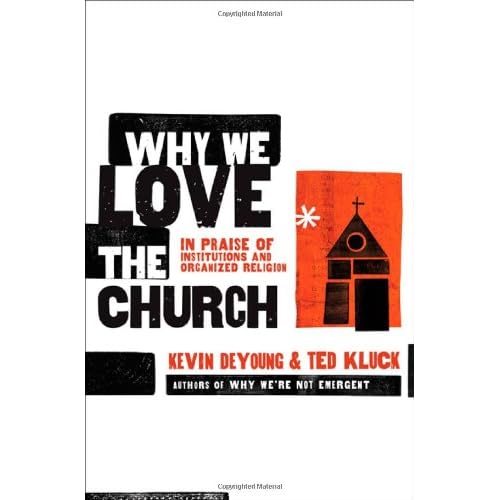
Review: Why We Love the Church


What can I say? Bagging the church has become so commonplace that writing about the AWESOMENESS of the church has become cool in a weird countercultural manner. It's so commonplace to find books about "community" and "religion (ie Church) is bad, spirituality (ie talking about God in Starbucks) is cool". But how often do you come across a book that argues FOR the Church?

In all seriousness - DeYoung and Kluck have put together a great book, worthy of its title. Mind you, this is no theological treatise examining constructs of the "visible vs the invisible" Church and so on, but a heartfelt, down-to-earth plea for Christians to come back to their senses; to stop talking about how one can find God in places like StarBucks and Enimem music, and to just love God and serve His people for who they are.

In this book, they discuss the (occassional) madness of the Emergent Church movement (and its merits), and then engage with all the "Disappointments" emergents often have with the church. And the conclusion at the end is not wholly unexpected - we know the Church isn't perfect, but whether you're emergent or reformed or pentecostal, you've got to learn to deal with it.

Mind you, the style of this book swings between bits by DeYoung and others by Kluck, but with surprisingly good effect - for reflectiveness and theological thoroughness of the former being balanced out by the humor and down-to-earth style of the latter.

Whilst they don't break any new ground in Ecclesiology, I would heartily recommend any Christian to read this book, simply for the fact that it draws us back to see the big picture - that we are God's people, broken, but eagerly awaiting our redemption. And the best place to do that, is with the Church.

Thursday, 18 February 2010

Phew, long time no post.

As the title goes. It's been a fairly hectic 4-5 months. Going back to Singapore, getting wedding plans sorting, starting work back here in Melbourne. Here's some material I've been able to get through during this period:

1. Health and Medicine in the Methodist Tradition, by Hollifield.

As the author says in the preface - trying to write about something Wesley never wrote about (specifically) is an immense challenge. This book was borne out of Wesley's noted interest in health and medicine (his famous/infamous booklet The Primitve Physicke is a case in point), as well as the tradition's ongoing theology and practical involvement in the field.

It is basically organised along particular themes - such as death, suffering and life/holiness as a journey. Each section explores what Wesley thought/wrote/believed about the theme, where the Methodists took this theme, and ultimately where we should/could be headed.

Hollifield does, in my opinion, do a good job of capturing and articulating Wesleyan approaches to key medical issues, applying Wesleyan theological concepts appropriately, and filling in the gaps using by extrapolating what was said/done before. Given the sparcity of reading on this topic within the Methodist tradition, this book is a gem.

2. Theology and Proclamation, by Willimon.

I've reviewed this book on my facebook page, but I'll outline some key thoughts. This book articulates a clear theology of preaching, looking at this divine act through various theological paridigms - such as Cross and Resurrection. In doing this, Willimon successfully lifts the preachers out of the pragmatic, "life application" ghetto they often finds themselves in.

A particular declaration from the book sums it up perfectly - the primary task of preaching is not to be applicable, or interesting; it is to be biblical. For there is nothing more applicable, nothing more fascinating than the Word of God. So if our sermons are boring and irrelevant, it is not a problem with style, it is fundamentally a problem with our substance. Willimon hammers this point in over and over, and inspiringly so.

3. Being Consumed, by Cavanaugh.

Also reviewed on facebook, Cavanaugh moves beyond typical "free market" vs "state interventionalist" approaches to economics. He in some ways deconstructs our modern concept of the free market, pointing out how modern economic paradigms fall apart in the face of particular theological realities of the Christian faith. For example, he critiques our idea of the "free market" by applying Augustinian values of freedom.

The chapters on economics are interesting enough, but Cavanaugh is primarily a theologian, and really comes into his own on the more "theological" chapters, such as one where he argues for the Eucharist as articulating an alternate socio-economic reality for Christians.

Some debatable points here (especially for those of a non-Roman Catholic background), but a valueable contribution to the discussion in this field.

4. Why We Love the Church, by Kluck and DeYoung.

I'm still reading this, so the review is to come.

Saturday, 3 October 2009

This is why we fight

In recent times, there have been some frustrating complications with church relationships and all, leaving me a bit frustrated and concerned. That same mood was carried with me into the Rosie's street ministry today, with me almost having to half drag myself out in the cold to serve the streeties.

However, during the night, I was brought back to reality, when one of our team members recounted how someone had been suicidal. She subsequently just sat and heard his story, prayed with him, and gave him a referral to LifeLine for support. After that, he said, in his own words, "This was the first time I've felt part of something".

At that point I realised - we get caught up in the details of life, in our frustrations and annoyances. We lose sleep over things that don't go our way, and our preoccupation is so often our struggle with life.

Yet, at the end of the day, we fight the good fight, not to put up a brave front to impress, or to polish our lives to sparkling perfection. We are fighting, contending, struggling for something bigger, greater, and beyond our own narrow little lives. It is the least of these that we are to struggle for: for the lives that Gods wants to touch and heal, for the broken people that He wants to comfort. We are fighting for the gospel, and for the ones that God loves.

This is why we fight; and believe it or not, God is on our side we are fighting on God's side.

Friday, 2 October 2009

Sad news - but inevitable?

I just received this mail from FORGE Australia:

For the last twelve years, Forge has sought to serve the Australian church by inspiring and training leaders to engage the first world as a mission field. We have had the privilege of working with many individuals and churches, helping catalyze missional initiatives and challenging the ecclesial status quo. Through God’s graces, we have seen significant shifts in the mindsets of Australian Christian leaders and for this rich and colorful journey, we are eternally grateful.

More recently, over the last two years we have been involved in a process of organizational reflection and future planning, seeking to identify what our contribution could be to the Australian church in the years ahead. After some long conversations and considered analysis of our position, we believe that the best way forward is to scale back all of our organizational operations for the foreseeable future."

As someone whose faith has benefited richly from the FORGE ministry, I'm really sad to hear this. I have been inspired, challenged and humbled by the many faithful members of FORGE. Seeing their zeal for missions in the West has rekindled a new flame and passion within my own heart for my neighbours and friends.

It is ironic, that the end the of the day, their basis for existence is to some extent the cause of their closure. In particular, they write:

Our current decentralized organizational structure has made it difficult to move ahead cohesively. The challenges associated with transitioning Forge to be an effective training organisation for the new context proved too costly.

FORGE has always pushed for a return to "Acts-style" churches, without the central administration and structure seen in "traditional churches", but rather an organic approach to church life. Thus, it doesn't come as a surprise that as FORGE grew, their commitment to "organic" administration meant that they did not have the administrative structure to support that growth.

While I'm sad to see FORGE Australia go, I think there's a great lesson in this - that at the end it's not all about "returning back to the good ol' days", it's about reaching people with the Gospel for the glory of God - and faithfully using whatever is available for those ends - even if they involve elaborate hierachies ;).

Saturday, 29 August 2009

Language, Culture and the Death of Me

We recently had a barbie where both English and Chinese services came together to "interact". First off, people who organised it, like Kat, Andrew and co., as well as others who pitched it are to be commended for their work - thank God and thank them that it was a great delicious event :).

*warning: Rant ahead*

My reflections however center on the irony of the event, most visibly demonstrated when the 2 services were asked to participate in certain activities together. These activities included the English service members, being asked certain "trivia" questions, in CHINESE, with no translation provided. Phew, thank God for that; I've always struggled with trivia, but not understanding the questions fixes all that!

The most ferrous-filled irony of the night occured when someone was speaking in Chinese about how great it was that the Chinese and English could come together to interact (or something to that effect), again with NO translation. When our Pastor and some other members asked that English be used or a translation provided, someone cheekily said "Sorry, my England no very good". Laughs all around, then back to a foreign language.

Ah, yes, the irony of saying "We love your participation, but we don't really care". /rantmode

And so a crossroads is once again met - having come with a real desire to support these initiatives, does one persist in faith, or shake the dust off the soles of my shoes? Is it a relationship that is in need of resuscitation, or are we beating a dead horse? (note: forgiveness and persistence are 2 very different things!)

Sunday, 19 July 2009

Emerging Churches - More Wesleyan than the Methodists?

In recent times I've had the opportunity to attend a FORGE conference and get my hands on some material by Hirsch and Frost, and essentially get a bit more up to date with the whole "emerging church" movement.

Much ink has been spilled over reservations about the whole movement, particularly over their interactions with more "traditional" mainline churches. I share the sentiments of many others (Glen has written some excellent comments here), feeling that they have many good things to offer, but do often come across as being a bit arrogant in the simplistic neglect of tradition. Nonetheless, I'm inspired by their commitment to serious discipleship (something which has definitely lapsed in many churches) as well as their intense missional focus, particularly in their service to the poor.

No doubt there are some questionable characters in the movement (I'm not a fan of McLaren), but amongst the more balanced people, I've been interested to find how much they have in common with the spirit of Wesleyanism. For example, in The Shaping of Things to Come, Hirsch and Frost write:

...what the church needs to find its way out of the situation it's in at the beginning of the 21st Century, is not more faddish theories about how to grow the church without fundamentally reforming structures. What the church needs is a revolutionary new approach.

They advocate that the church need to restructure itself around the concept of mission (rather than worship, which is very prevalent today), on the basis that:

...the missional church represents God in the encounter between God and human culture....it is a visible manifestation of how the Good News of Jesus Christ is present in human life and transforms human culture to reflect more faithfully God's intentions for creation.

In other words, our construct of ministry and mission should not and must not be centered within what we call "Church". "Ministry" is not just about ushering, leading worship or playing the piano - it is also very much (and more so!) about MISSION - our engagement and interaction with the world the other 6 days of the week. For many, it is thus lamentable that church structures and organisations are so church-centered - we encourage people to attend prayer meets, cell groups, sunday schools, choirs, courses, seminars, workshops, meetings, etc, hence effectively taking people OUT of their community and keeping them IN the Church.

Hirsch and Frost see this church centered functioning as a logical outcome of "traditional" ways of church organisation and institutionalisation, and hence call for a radical restructuring of our churches, at points calling us to return to "primitive" Christianity.

What struck me was how similar this sounded to the Wesleys as they began their ministry. Chilcote, in The Wesleyan Tradition, comments on the Wesleys' beliefs:

The church of England in the Wesleys' day was an institution in need of repair...It had become distant from and irrelevant to the world it was called to serve during a time of tremendous change. Its forms and its structures had become so inflexible and devoid of life that the weight of its "institutionalism" was quenching the Spirit, suffocating the life of God's people....It needed to rediscover itself and reclaim its identity as God's agent of love in the world. The Wesleys believed that God raised them up to resuscitate the church.

Commenting on the Wesleys' understanding of the function of the church, he says:

Their ecclesiology (understanding of the church), therefore, was essentially missiological (formed around mission)... All of their energy was directed toward the empowerment of Christ's fiathful disciples in ministry to God's world. Indeed, they all viewed evangelism and mission...as the reason for their existence.

Given that the Methodist Church today has become more well known for being "Methodical" (in terms of beauracracy and red tape, rather than in the pursuit of holiness), I can't help but wonder whether the much maligned "Emerging Church" movement actually better embodies what it means to be a Methodist than many Methodists, by demonstrating a stronger passion for a more missional, discipleship oriented, and contextual approach to church life.

However, perhaps more importantly, how do we as a church rediscover what it means to be "missional" - what sacrifices and pains will it take, and will we take them?

Wednesday, 15 July 2009

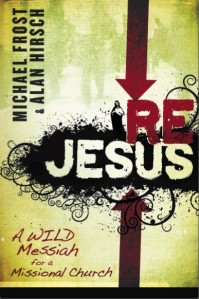
Review for "ReJesus - A wild messiah for a missional Church' by Hirsch and Frost


Hirsch and Frost are concerned only with 1 word - J.E.S.U.S. Call them what you may, but their premise is simple: the modern western church has strayed far from the teachings and values that its founder Jesus Christ embodied - he has been domesticated to fit our agenda. Echoing characters such as Barth, they declare that Christ must remain central in the faith, as nothing can be known/felt/done apart from Christ himself. To make their point, they go through 7 chapters that discuss (in order): how Jesus impacts theology/missiology/ecclesiology, how he impacts individuals and how he impacts communities. They explore the false images we've made of Jesus, and how the Shema provides a holistic model for discipleship in the form of monotheistic ethics. They go on to discuss the importance of intersecting orthodoxy, orthopraxy and orthopathy, and finish off with a discussion on ecclessiology (which is admittedly very functional).

In general I'm quite wary of these kind of books (that proclaim that 'everyone is wrong and we just need to get back to basics'), as they often have a blaise disregard for the value of tradition and history. The authors constantly affirm the value of tradition, thankfully, but provide few insights into how this may be reinterpreted in the context of a renewed Christologic focus, so as to avoid throwing the baby out with the bathwater.

This, however, does not hurt their main, and very timely message - that we need to rescue the gospels (and Christology) from the dungeons, and place them and their central figure back at the center of our existence as the church. In doing this, they rightly argue, the church will rediscover what it means to be "missional", in every sense of the word, as they embody the values of their Lord. Rather than the tame, gentle, huggable, nice lady-like Jesus of our paintings, they present a challenging, radical, loving, confrontational, non-conformist and passionate Jesus. This they do very well, with a good mix of anecdote and story to add some personal flavor to their writings, leaving one with the challenge to read the Gospels more intently, keeping our eyes and heart open to the person they testify to.

Ironically, the book is short on the very material it seeks to promote - Christology. There's plenty of discussion around the impact that Christology would have, but not much exploration of the man himself - but perhaps that is too much of an ask for a book only 200 pages long! In addition, attempts at serious theological reflection (such as the section on ecclesiology) are pretty flimsy, but then again, this book is more about the importance of prioritising Christology than an actual discussion of the subjects themselves.

All in all, ReJesus is a good read that will no doubt stir the reader to rethink and reflect on putting the Christ back into being Christian, and learn to read the gospels more robustly, leading to a reinterpretation of the identity of the church. In a sense, what Barth did as a theologian, Hirsch and Frost are doing as missionaries. It gets pretty draggy and repetitive at points, but remains a great starting point for discussion on ministry.

Thursday, 2 July 2009

Biblical Preaching by Haddon Robinson


This book is immensely practical - it takes you on a step by step journey through the preparation and delivery of sermons. It covers topics ranging from selection of a text and its exegesis, to the development of a homilectical theme, and finally to the to nuances and issues in delivery of the message (Eg: body language, voice etc).

The breadth of topics Robinson tries to cover seems intimidating, and one wonders whether the book becomes a jack of all trades, without really detailing any particular step. Robinson however makes up for this, by ensuring maximum clarity by keeping the points simple, and filling the pages with examples. He also makes it a point to direct the reader to more indepth resources at the each chapter, if one wishes to pursue it. More worked examples, however would have been useful.


One glaring deficiency in the book, however, is how a clear theology of preaching is not outlined. Although the book sets out to be more practical than theoretical, it would not have hurt to have discussed the biblical and theological basis for speaking the word of God (beyond the few paragraphs mentioned in the introduction and the final chapter).


All in all, this stands as a clear and valueable introduction to the preparation and delivery of sermons. Whilst you won't get a comprehensive exploration of preaching ministry, you will be getting a solid, and all-round guide to get started in this ministry.

Sunday, 21 June 2009

So I watched Constantine...


A bit of an oldie I know, but I never got round to watching it. On the whole, I'll say it's a pretty bad movie - crappy plot, and filled with horrible theological concepts (kind of like those movies that potray Chinese as yellow skinned slanty eye people with pig tails?).

Anyway, there were actually 2 bits in the movie that I liked (spoilers ahead):

1. When Gabriel pins Constantine to the ground, he/she/it (angels are neuter) comments on how humans just need to repent to enter into the bosom of God, and how privileged and loved we are above all of God's other creations. It then caps it off by saying "It's not fair".

At this point I was groaning from the badness of the movie, but this little bit perked me up a little, simply because it reflected the awesome theological truth - that the Son of God should give His life for fallen humanity, that He should take on the form of the human and no other creature. Yes God loves His creation, but there is little doubt that humanity has a treasured place in that. And furthermore, at the end of the day, the Gospel of Jesus Christ ISN'T fair - in no way is there any "fairness" in us being reconciled to God by the suffering of God Himself!

2. As Lucifer tries to drag Constantine to hell as punishment for his sin, God stops him in his tracks and lifts Constantine to heaven, much to Lucifer's chagrin. At this point, Constantine gives Lucifer the birdie, and was really a LOL moment for me.

You see, I couldn't help but reminded of how we often get caught up into appearance and etiquette, thinking that God is looking out for the well mannered nice person, but has no interest in the ruffian who swears and is ill mannered. But at the end of the day, we come back to the parable of the Good Samaritan, where the evil, uncouth Samaritan is praised as living closer to God's command to "love thy neighbor", than any of the Jews coming before him.

It's so tempting to measure holiness (particularly in our conservative Chinese church) by, in a sense, "niceness". Yet, perhaps God is sometimes less concerned about whether you are nice and polite, than whether you are living out His command to love God with all you've got, and love your neighbor like yourself.

Saturday, 13 June 2009

A Review of God's Politics: Why the Right is Wrong and the Left Doesn't Get it

"We are the one's we are waiting for" - this pretty much sums up what Wallis is arguing for in this book: a desire for the church to rediscover it's duty to engage with society, and push for social reform on critical issues of peace, justice, international aid, etc. Whilst the mention of 'politics' and 'God' is bound to raise suspicion given the necessity of the separation of Church and state, Wallis is clear to emphasize that he is not promoting the development of a "Christian nation (as some fundamentalists insist on)", but the development of a political stance amongst Christians that is congruent with the values of our faith, achieved not through coercian but through accepted means.

The book is targeted at Christians, and discusses the foundational concern that (in the US at least) religion has been hijacked by political groups for their own means. Christians are often pressured to believe that if they want to be faithful, they MUST vote for the republicans, as if God is pro-war, pro-rich, etc. On the other hand, the democrats have been fearful of touching on the matter of religion, thus alienating an otherwise significant voting group. Wallis attempts to point out how Christians have to lift themselves out of the "Left" vs "Right" dichotomy, and begin to establish a politic that reflects scriptural values, such as that of the family, whilst being progressive in engaging with society, such as caring for the poor, fighting racism and sexism, etc.

Wallis calls Christians to step out from apathy, to begin engaging with their role as responsible citizens who have to speak as a common voice, and hold politicians to account on their commitments. Through the use of multiple case examples, he demonstrates that when Christians and other religious folk band together on moral issues, such as black civil rights and the abolition of slavery, their voice over time is heard by the powers at large, and that change can come.

The main downside of the book is that it seems a little self indulgent at times and repetitive. Wallis inserts one too many examples of how he and some other leaders wrote this letter, made this statement or did this work. On the other hand, these little snippets do provide some thought as to how Christians can speak up about these issues. Even then, he doesn't spend enough time fleshing out the alternatives to the abuses that are seen daily in the political arena. In addition, Wallis does ignore the (thankfully rare) scenario where evil just meets any attempt at meaningful engagement face-on with a hammer. However, I suspect that Wallis' approach is something meant for the Church in a democratic environment, rather than in an oppressed one.

On the whole, God's Politics makes a fascinating read for Christans who are thinking about how their faith interacts with their public life - to neither divorce them nor create a false simple unity. Whilst it seems to wander a little bit, by the end of it the reader is left with a sense of hope (a rarity in these discussions), that the Church can continue in the footsteps of other "prophetic" voices such as Martin Luther King and William Wilburforce, to make a meaningful impact on society.

Friday, 8 May 2009

A review of "Medicine as Ministry" by M. Mohrmann

First off, it is worthwhile to note that Mohrmann is one of the few people who have the background, experience and training to write a book about theological ethics and medical practice - she is shared between a professorial chair of paediatrics, and an associate professorial chair in religion, at the university of virginia. Thus, unlike many doctors who do not have the breadth of knowledge/reading to comment in an indepth fashion on ethics, or the theologians who largely remain strangers to the world of medicine, Dr Mohrmann is able to unite the best of both worlds, and hence what she says has a very practical, yet deeply reflective element to it.

On to the book - this is not an exaustive treatise on biomedical ethics. As the title "reflections on suffering, ethics and hope" suggests, it is a book exploring what it means to be a doctor in a suffering world, and how we react to it.

Rather than offering a case-by-case discussion of the various areas of controversy, Mohrmann chooses instead to focus on the question of what "ethics" means to christians, and where this "ethics" comes from. The book, in rough order, reflects on the meaning of the trinitarian God for ethics, and necessity of engaging with the rich narratives of our patients' lives in order for medical practice to truly reflect what God intends it to be. Her arguement centers much on the narrative nature of human experience, and the need for broader engagement with the community of a patient for true healing to occur.

This book is more thought provoking than answer giving, as Mohrmann freely challenges our views of health, life and dying, even suggesting that we have idolised life itself. Nonetheless, Mohrmann is able to keep the book thin and make it a light read (I finished it 3-4 hours).

People looking for straightforward analyses of specific moral dilemmas and answers to life questions need not read this book - it is meant to stimulate thought on approaching our ethics differently, and in the process of doing so, enable us to fulfill the commandment to love our neighbours more meaningfully.