Showing posts with label book review. Show all posts

Friday, 27 May 2011

Book review: The Demon Under the Microscope, By Hager


As human beings, we have relatively short memories; we have largely forgotten what life was like barely 90 years ago, when human lives were far too often cut short by relatively simple infections (by today's standards). Most of us have lost touch with the time when epidemics of "childbed fever" meant that almost all women giving birth in the hospital would die from infection; when a simple blister on the toe could lead to deadly, incurable bacterial sepsis.

Hager's book is an excellent reminder of how far we've come. It is largely narrative history, written with the aim of communicating the processes and ideas that led to the development of sulfa (the world's first true antibiotic), rather than a straightforward chronological account.

Hager begins right at the start, when microscopic world was first discovered, and how it led to the development of germ theory. He carries us through the development of antiseptic use and serum therapy, moving us from a time where surgeons merely placed their instruments on any convenient table, to a period when theatres were constantly filled with aerosolised antiseptic blown from a bellows.

The real start of the show, however, is Nobel Prize winner Domagk (and of course his much neglected chemists), who led the clinical research that culminated in the discovery of the antimicrobial properties of sulfa. Their pains and toils are remarkably communicated by Hager, giving us a definite sense of disappointment after years of unfruitful research. At the same time, due credit is given to other parties involved in the discovery - including French researcher Forneau.

The stories doesn't just stop at the discovery of sulfa - Hager also gives us an account of how the FDA and a haphazard medicinal drug market was transformed overnight into a well organised, highly vigilant industry.

All in all, this is a fantastic book - not just for an insight into the discovery of sulfa, but the ideological and scientific struggles surrounding the idea of a antimicrobial "magic bullet", and the challenges that sulfa placed forth to the world - that of the need for careful, well designed and executed clinical drug research. Most of all, this is a book that reminds us of where we've come from, where we are now, and raises question of where we are headed, in our constant battle with the microscopic enemies in our midsts - an issue particularly pertinent with worrying trends in bacterial resistance.

Wednesday, 27 April 2011

Book review: Unscientific America by Mooney and Kirshenbaum

In this book, Mooney and Kirshenbaum (I'll just refer to Mooney from now on) address the key issue of scientific illiteracy - the decline of scientific awareness and engagement with the public, and the dangerous implications it has for the future. He splits his chapters up into key topics - describing the current situation, how we got here, the issues behind the decline in various disciplines (eg: science in culture, science in movies, science in schools), hot topic issues such as the new atheism, and what can be done about it all.

I really want to like much more than I did, for good reason - it's centred on an issue that I'm (somewhat) interested in: scientific illiteracy. Mooney shares the same desire as I do - that people become more aware of the wonderful progress being made in scientific fields, that science conciously becomes a integral part of society, and that more people take consider pursuing science as a career path for the sheer love of it. In my case, my career direction (As a doctor) was most impacted when I was barely 10, by a "Book of Science" (that I still have) which contained some of the most marvellous pictures of the human body (dissected down to the level of vessels). I think my parents must have thought I was crazy to have placed "B.Science/Arts (combined)" right after "MBBS" on my university course preference list (I do have a crazier medical colleague who put B.Education as his second choice). So for sharing this passion, and communicating it in a easy and readable manner, Mooney scores some points.

But why doesn't this book score higher? Well, Mooney loves the scientific process no doubt, but underlying his entire book is a very questionable stance on what "science" is, and it's relation to the rest of society. Take for example, Mooney's discussion on the nature of science - which he describes as the description of an objective reality, compared to the humanities, which make a fool of reality. (He tries to be fair to the humanities, but he still comes across as poo-pooing them. Eg: His chapter on science and entertainment starts with a mockery of the idea that movies don't need to follow the natural order) He more or less completely dismisses post-modern philosophy in a few sentences, without showing evidence of engagement with some of the serious epistemology challenges it throws to scientific research. Even Stephen Hawking, in his new book The Grand Design, makes an admission that traditional "realism" is no longer a tenable position, not in light of post-modern philosphy, but in the context of new knowledge of the quantum world.

In addition, he repeated uses the word "science", like it were some holy grail - he says "we must fund science/protect science/encourage science", but never really deals the whole question of "what is science" - is it a concept, a philosphy, a defineable entity? He writes in such a way that one could be mistaken for thinking that science is a god to be worshipped, and that anyone who doesn't recognise that is a moron.

It is this "holier -than-thou" attitude, masked by what seems like a false sense of humility (he repeatedly says "Scientists are somewhat at fault to, for not doing enough to make sure things are done the proper way"), that marrs the entire book. For example, he complains that in politics, decisions are made not on careful analysis, but rather on ideology and political belief (well, surprise surprise, but ideology and political belief does form the entire framework on how we perform our analysis).

There is ultimately no clear outline on what exactly accounts for "Scientific literacy" is, and what differentiates it from scientific illiteracy. For example, he mocks things such as the Reagan "star wars" project as examples of stupidity, but then heaps praise upon projects that were once "Dreams" but have become reality (eg: space flight).

Scientific America is a book that for all intents and purposes addresses a key issue, not just in America but all over the world, even in Singapore (despite our world record science and math scores, how many of our students can actually apply critical scientific thinking to problems?). But ultimately, it comes across as too much of a kopitiam whinge, than a well thoughtout engagement with the key issues at hand (although there some points that shine through).

Wednesday, 2 March 2011

Review: 6 Feet Over

This book should be entitled - "adventures in the apparent physical manifestations of the afterlife". In this book, Roach approaches the issue claims of experiences of the afterlife as a skeptic, looking at the evidence closely and with a healthy dose of salt. She comes away, unsurprisingly, as a....skeptic.

To understand why, you only need to look at the central topics upon which she focuses. These range from reincarnation (she goes to india, interviewing experts on the topic and sitting in on interrogations of supposed "reincarnated persons"), to investigating mediums (And the ectoplasm craze), before capping it off with an examination of near death experiences.

The only firm conclusion that she can come away with is - there really isn't any. This is due to a number of factors - mostly related to poor evidence, but also the nature of the object of study (ie: if an event is uniquely supernatural, occurring not at fixed pattern but at the whim of invisible beings, one cannot perform a quantitative study, and can only remain in the domain of qualitative science).

Peppered with hilarious remarks, many finding inspiration from the loose nuts she finds on her journey, this is a great read, for both believers and skeptics alike.

Review: 13 Things That Don't Make Sense

Brooks writes about 13 "anomalies" in the scientific world that refuse to fit into our nicely formulating theorems and paradigms. His writings can be largely grouped into two subsets - physics and biology (with chemistry interspersed along the way). For the former, he looks at issues such as dark matter and evidence of changes in universal constants (Eg: the speed of light). For the latter, he explores matters such as the placebo effect and the quest for a working definition of "life".

As I read this book, I couldn't help but have a stirring within me - a love for science in it purest, curious form, and an amazement at the marvels and curiousity of the creation. You see, One of my favourite books of all time is a guide to science by Isaac Asimov; Asimov's explanation of the world of physics left me in awe - I fondly remember discussions I had with friends on how relativity, amongst other things, had so many strange and marvellous implications for our understanding of the world. I remember spending nights in high school trying to wrap my head around quantum theories (who can forget Shroedinger's cat).

Why mention all this? I feel that this book embodies that philosophy in its approach to science - an inquisitive nature that revels in the challenge of discovering why the world works the way it does. Brooks at more than one point evokes Kuhn and his discussion of crisis leading to the (now cliched) paradigm shift, and he does it with good reason - Brooks is arguing at many of these anomalies in science just don't fit with our current paradigms, and could potentially force a complete rethink of our current systems. In short, look at the world around you, and don't be afraid to ask questions if things don't make sense - not with a fear that everything will collapse if you do, but with a confidence that somehow, someway, we'll come up with an even better way of explaining the world around us.

I don't know about you, but I find the thought of doing that strangely exciting.

Thursday, 6 May 2010

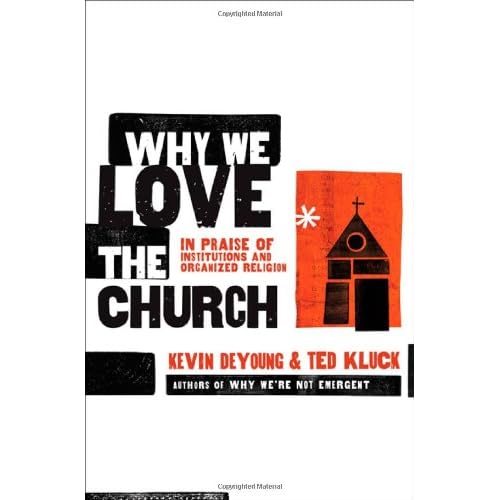
Review: Why We Love the Church


What can I say? Bagging the church has become so commonplace that writing about the AWESOMENESS of the church has become cool in a weird countercultural manner. It's so commonplace to find books about "community" and "religion (ie Church) is bad, spirituality (ie talking about God in Starbucks) is cool". But how often do you come across a book that argues FOR the Church?

In all seriousness - DeYoung and Kluck have put together a great book, worthy of its title. Mind you, this is no theological treatise examining constructs of the "visible vs the invisible" Church and so on, but a heartfelt, down-to-earth plea for Christians to come back to their senses; to stop talking about how one can find God in places like StarBucks and Enimem music, and to just love God and serve His people for who they are.

In this book, they discuss the (occassional) madness of the Emergent Church movement (and its merits), and then engage with all the "Disappointments" emergents often have with the church. And the conclusion at the end is not wholly unexpected - we know the Church isn't perfect, but whether you're emergent or reformed or pentecostal, you've got to learn to deal with it.

Mind you, the style of this book swings between bits by DeYoung and others by Kluck, but with surprisingly good effect - for reflectiveness and theological thoroughness of the former being balanced out by the humor and down-to-earth style of the latter.

Whilst they don't break any new ground in Ecclesiology, I would heartily recommend any Christian to read this book, simply for the fact that it draws us back to see the big picture - that we are God's people, broken, but eagerly awaiting our redemption. And the best place to do that, is with the Church.

Thursday, 18 February 2010

Phew, long time no post.

As the title goes. It's been a fairly hectic 4-5 months. Going back to Singapore, getting wedding plans sorting, starting work back here in Melbourne. Here's some material I've been able to get through during this period:

1. Health and Medicine in the Methodist Tradition, by Hollifield.

As the author says in the preface - trying to write about something Wesley never wrote about (specifically) is an immense challenge. This book was borne out of Wesley's noted interest in health and medicine (his famous/infamous booklet The Primitve Physicke is a case in point), as well as the tradition's ongoing theology and practical involvement in the field.

It is basically organised along particular themes - such as death, suffering and life/holiness as a journey. Each section explores what Wesley thought/wrote/believed about the theme, where the Methodists took this theme, and ultimately where we should/could be headed.

Hollifield does, in my opinion, do a good job of capturing and articulating Wesleyan approaches to key medical issues, applying Wesleyan theological concepts appropriately, and filling in the gaps using by extrapolating what was said/done before. Given the sparcity of reading on this topic within the Methodist tradition, this book is a gem.

2. Theology and Proclamation, by Willimon.

I've reviewed this book on my facebook page, but I'll outline some key thoughts. This book articulates a clear theology of preaching, looking at this divine act through various theological paridigms - such as Cross and Resurrection. In doing this, Willimon successfully lifts the preachers out of the pragmatic, "life application" ghetto they often finds themselves in.

A particular declaration from the book sums it up perfectly - the primary task of preaching is not to be applicable, or interesting; it is to be biblical. For there is nothing more applicable, nothing more fascinating than the Word of God. So if our sermons are boring and irrelevant, it is not a problem with style, it is fundamentally a problem with our substance. Willimon hammers this point in over and over, and inspiringly so.

3. Being Consumed, by Cavanaugh.

Also reviewed on facebook, Cavanaugh moves beyond typical "free market" vs "state interventionalist" approaches to economics. He in some ways deconstructs our modern concept of the free market, pointing out how modern economic paradigms fall apart in the face of particular theological realities of the Christian faith. For example, he critiques our idea of the "free market" by applying Augustinian values of freedom.

The chapters on economics are interesting enough, but Cavanaugh is primarily a theologian, and really comes into his own on the more "theological" chapters, such as one where he argues for the Eucharist as articulating an alternate socio-economic reality for Christians.

Some debatable points here (especially for those of a non-Roman Catholic background), but a valueable contribution to the discussion in this field.

4. Why We Love the Church, by Kluck and DeYoung.

I'm still reading this, so the review is to come.