Showing posts with label theology. Show all posts

Sunday, 26 July 2015

Why My Son Was Baptised: Part 2

Having established the biblical and traditional foundations for affirming the efficacy of Baptism, we next explore the question of "what is it efficacious for"?

Starting again from scripture and examining the texts previously referenced in Part I, we find that a parallel is drawn between baptism and circumcision. Circumcision, an act initiating an individual into God's covenant community in the Old Testament, is aligned with the practice of baptism in the New Testament (Col 2: 11-12). Although the scriptures remain firm on the centrality of faith and obedience in bringing meaning to the act of circumcision (1 Cor 7: 19), they do not divorce inward faith from the external act. Utilizing this framework, we come to an understanding of baptism that underscores it's centrality in the Church's mission and life - that through this act God incorporates an individual into the greater body of Christ (1 Cor 12:13), God's new covenant community established in light of the death and resurrection of Jesus Christ. 

St. Athanasius, in his response to the Arian controversy, relied heavily on this understanding of baptism to defend the co-divinity of the Father, Son and Holy Spirit:
The faith in the Trinity transmitted to us is the only one, and it unites us with God, and whoever takes something away from the Trinity and baptizes in the name of the Father, or in the Son alone, or into the Father and the Son without the Spirit, receives nothing, but those being baptized and he imagines himself to be giving baptism remain in vanity and unconsecrated, because the Mystery is accomplished in the name of the Trinity: so that whoever separates the Son from the Father or reduces the Spirit to a creature has neither the Son nor the Father but is an atheist, worse than an unbeliever, and anything but a Christian.
Implicit within his argument is the assumption that the efficacy of baptism is driven by the power of the Trinitarian God, subsuming the individual into the divine life of the Trinity and hence into the Church as Christ's body. Thus, a failure to appropriately recognize the effector of this act leads to a baptism that is inefficacious for true Christian conversion, leaving nothing accomplished in the unseen realm and keeping the individual separate from true union with the body of Christ. 

This close relationship between a sacramental understanding of baptism and the Church may be readily observed today: in communities where a robust and well-developed eccelesiology is articulated, a  deeply sacramental understanding of baptism continues to be practiced (e.g. Anglicanism, Roman Catholicism, Lutheranism), with a recognition of the integral part it plays in Christian faith and practice. Likewise, Christian communities with a less established ecclesiology typically downplay the significance of baptism. As unfortunate as it is, this latter pattern has become pervasive in protestantism, driven by an individualism which has been characteristic of a post-modern worldview emphasizing individual belief and opinion against corporate confession and belief.

In summary, an examination of scripture as well as tradition suggests the following regarding baptism:
  1. Baptism is more than a "symbolic" act of an inward conversion. Rather, baptism performed in the context of faith, is an act demanded by God of the Church, in which He effects a change in the life of the recipient.
  2. The effect of baptism is tied closely to the believer's participation in the life of the Church; God has made it normative that all who come to faith are to be baptized into the body of Christ (However, normativity does not necessarily translate into exclusivity; someone who confesses faith in Christ and dies before being baptised will still be saved).

Tuesday, 21 July 2015

Why My Son Was Baptised: Part I


My son Benjamin was recently baptised on the 19th of July 2015 at Wesley Methodist Church; since then I have received a few queries on why I practice infant baptism. Having reflected on this very issue leading up to the decision to have him baptised, I decided it best to pen my thoughts down and crystallize them in prose.

Within that query, there are two separate questions which need to be addressed - the act itself (i.e. baptism) and the adjective that defines that act (i.e. infant).

Regarding baptism, the two sub-issues most pertinent to Protestants are "Is baptism just a symbol of belief, or is it efficacious in and of itself?" and "What is it efficacious for?"

Protestantism today often reduces baptism to an act of symbolism, in which a believer makes an outward declaration of a new-found faith. The act in this case is always secondary, being borne out of, but not influencing the inward rebirth of the believer being baptised. I would propose that this is not the case; that baptism has an efficacy in the inner life of the recipient of the sacrament, whilst remaining contingent on the necessity of faith (although this may not necessarily be the faith of the believer, as I shall discuss later).

Taking scripture as the starting point, we don't find much teaching about baptism per se; although the biblical authors repeatedly reference baptism throughout the New Testament, these references are indirect - i.e. there are no teachings on what baptism is, only assumptions on behalf of the reader on its significance and meaning. Nonetheless, we repeatedly find that baptism is associated with the death of old-self (Romans 6:4), has regenerative connotations (Colossians 2:12), is fundamental in the mission of the Church (Matt 28:19), and is considered a normative practice of the Christian faith (Acts 2:38). The use of baptism in these scriptures suggests that it is more than a optional act symbolic of inward faith; rather it points to a deeper reality that make it a core part of Christianity.    

As we move on from the New Testament to the teachings of the church fathers, we find a similar emphasis on baptism having value beyond mere symbolism. St Augustine taught that the sacraments of the Church (including baptism) were "outward and visible signs of an inward and invisible grace", indicating that there was an invisible but definite link between the physical act and the inward workings of God. Likewise, Tertullian, in reference to the baptismal waters, wrote that "the material substance which governs terrestrial life acts as agent likewise in the celestial", again highlighting an unseen connection between the physical act of baptism and spiritual work of God. 

This understanding of baptism (and sacraments in general) was actually considered orthodox until the reformation, where Zwingli, amongst others, de-emphasised the spiritual nature of the sacraments (particularly baptism and the Eucharist), turning instead to their memorial and symbolic nature. It is interesting to note that other leaders of the Protestant movement, such a Luther, still had a very high view of the sacraments, teaching that God's activity was very much present in the recipient of the sacrament at the moment of administration. 

Our popular understanding of the sacraments has continued to be eroded, perhaps largely due to a reductionist, modernist mindset that rejects the divine and supernatural where it is deemed unnecessary. Such an approach has crept into our thought and practice over the centuries, leading us to abandon much of the divine beauty and mystery of the Christian faith, replacing it instead with down-to-earth and rational explanations of our practices and traditions. 

Thursday, 6 May 2010

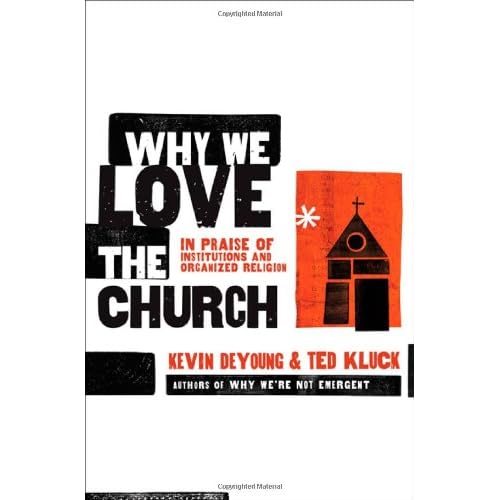
Review: Why We Love the Church


What can I say? Bagging the church has become so commonplace that writing about the AWESOMENESS of the church has become cool in a weird countercultural manner. It's so commonplace to find books about "community" and "religion (ie Church) is bad, spirituality (ie talking about God in Starbucks) is cool". But how often do you come across a book that argues FOR the Church?

In all seriousness - DeYoung and Kluck have put together a great book, worthy of its title. Mind you, this is no theological treatise examining constructs of the "visible vs the invisible" Church and so on, but a heartfelt, down-to-earth plea for Christians to come back to their senses; to stop talking about how one can find God in places like StarBucks and Enimem music, and to just love God and serve His people for who they are.

In this book, they discuss the (occassional) madness of the Emergent Church movement (and its merits), and then engage with all the "Disappointments" emergents often have with the church. And the conclusion at the end is not wholly unexpected - we know the Church isn't perfect, but whether you're emergent or reformed or pentecostal, you've got to learn to deal with it.

Mind you, the style of this book swings between bits by DeYoung and others by Kluck, but with surprisingly good effect - for reflectiveness and theological thoroughness of the former being balanced out by the humor and down-to-earth style of the latter.

Whilst they don't break any new ground in Ecclesiology, I would heartily recommend any Christian to read this book, simply for the fact that it draws us back to see the big picture - that we are God's people, broken, but eagerly awaiting our redemption. And the best place to do that, is with the Church.

Thursday, 18 February 2010

Phew, long time no post.

As the title goes. It's been a fairly hectic 4-5 months. Going back to Singapore, getting wedding plans sorting, starting work back here in Melbourne. Here's some material I've been able to get through during this period:

1. Health and Medicine in the Methodist Tradition, by Hollifield.

As the author says in the preface - trying to write about something Wesley never wrote about (specifically) is an immense challenge. This book was borne out of Wesley's noted interest in health and medicine (his famous/infamous booklet The Primitve Physicke is a case in point), as well as the tradition's ongoing theology and practical involvement in the field.

It is basically organised along particular themes - such as death, suffering and life/holiness as a journey. Each section explores what Wesley thought/wrote/believed about the theme, where the Methodists took this theme, and ultimately where we should/could be headed.

Hollifield does, in my opinion, do a good job of capturing and articulating Wesleyan approaches to key medical issues, applying Wesleyan theological concepts appropriately, and filling in the gaps using by extrapolating what was said/done before. Given the sparcity of reading on this topic within the Methodist tradition, this book is a gem.

2. Theology and Proclamation, by Willimon.

I've reviewed this book on my facebook page, but I'll outline some key thoughts. This book articulates a clear theology of preaching, looking at this divine act through various theological paridigms - such as Cross and Resurrection. In doing this, Willimon successfully lifts the preachers out of the pragmatic, "life application" ghetto they often finds themselves in.

A particular declaration from the book sums it up perfectly - the primary task of preaching is not to be applicable, or interesting; it is to be biblical. For there is nothing more applicable, nothing more fascinating than the Word of God. So if our sermons are boring and irrelevant, it is not a problem with style, it is fundamentally a problem with our substance. Willimon hammers this point in over and over, and inspiringly so.

3. Being Consumed, by Cavanaugh.

Also reviewed on facebook, Cavanaugh moves beyond typical "free market" vs "state interventionalist" approaches to economics. He in some ways deconstructs our modern concept of the free market, pointing out how modern economic paradigms fall apart in the face of particular theological realities of the Christian faith. For example, he critiques our idea of the "free market" by applying Augustinian values of freedom.

The chapters on economics are interesting enough, but Cavanaugh is primarily a theologian, and really comes into his own on the more "theological" chapters, such as one where he argues for the Eucharist as articulating an alternate socio-economic reality for Christians.

Some debatable points here (especially for those of a non-Roman Catholic background), but a valueable contribution to the discussion in this field.

4. Why We Love the Church, by Kluck and DeYoung.

I'm still reading this, so the review is to come.

Sunday, 19 July 2009

Emerging Churches - More Wesleyan than the Methodists?

In recent times I've had the opportunity to attend a FORGE conference and get my hands on some material by Hirsch and Frost, and essentially get a bit more up to date with the whole "emerging church" movement.

Much ink has been spilled over reservations about the whole movement, particularly over their interactions with more "traditional" mainline churches. I share the sentiments of many others (Glen has written some excellent comments here), feeling that they have many good things to offer, but do often come across as being a bit arrogant in the simplistic neglect of tradition. Nonetheless, I'm inspired by their commitment to serious discipleship (something which has definitely lapsed in many churches) as well as their intense missional focus, particularly in their service to the poor.

No doubt there are some questionable characters in the movement (I'm not a fan of McLaren), but amongst the more balanced people, I've been interested to find how much they have in common with the spirit of Wesleyanism. For example, in The Shaping of Things to Come, Hirsch and Frost write:

...what the church needs to find its way out of the situation it's in at the beginning of the 21st Century, is not more faddish theories about how to grow the church without fundamentally reforming structures. What the church needs is a revolutionary new approach.

They advocate that the church need to restructure itself around the concept of mission (rather than worship, which is very prevalent today), on the basis that:

...the missional church represents God in the encounter between God and human culture....it is a visible manifestation of how the Good News of Jesus Christ is present in human life and transforms human culture to reflect more faithfully God's intentions for creation.

In other words, our construct of ministry and mission should not and must not be centered within what we call "Church". "Ministry" is not just about ushering, leading worship or playing the piano - it is also very much (and more so!) about MISSION - our engagement and interaction with the world the other 6 days of the week. For many, it is thus lamentable that church structures and organisations are so church-centered - we encourage people to attend prayer meets, cell groups, sunday schools, choirs, courses, seminars, workshops, meetings, etc, hence effectively taking people OUT of their community and keeping them IN the Church.

Hirsch and Frost see this church centered functioning as a logical outcome of "traditional" ways of church organisation and institutionalisation, and hence call for a radical restructuring of our churches, at points calling us to return to "primitive" Christianity.

What struck me was how similar this sounded to the Wesleys as they began their ministry. Chilcote, in The Wesleyan Tradition, comments on the Wesleys' beliefs:

The church of England in the Wesleys' day was an institution in need of repair...It had become distant from and irrelevant to the world it was called to serve during a time of tremendous change. Its forms and its structures had become so inflexible and devoid of life that the weight of its "institutionalism" was quenching the Spirit, suffocating the life of God's people....It needed to rediscover itself and reclaim its identity as God's agent of love in the world. The Wesleys believed that God raised them up to resuscitate the church.

Commenting on the Wesleys' understanding of the function of the church, he says:

Their ecclesiology (understanding of the church), therefore, was essentially missiological (formed around mission)... All of their energy was directed toward the empowerment of Christ's fiathful disciples in ministry to God's world. Indeed, they all viewed evangelism and mission...as the reason for their existence.

Given that the Methodist Church today has become more well known for being "Methodical" (in terms of beauracracy and red tape, rather than in the pursuit of holiness), I can't help but wonder whether the much maligned "Emerging Church" movement actually better embodies what it means to be a Methodist than many Methodists, by demonstrating a stronger passion for a more missional, discipleship oriented, and contextual approach to church life.

However, perhaps more importantly, how do we as a church rediscover what it means to be "missional" - what sacrifices and pains will it take, and will we take them?

Wednesday, 15 July 2009

Review for "ReJesus - A wild messiah for a missional Church' by Hirsch and Frost


Hirsch and Frost are concerned only with 1 word - J.E.S.U.S. Call them what you may, but their premise is simple: the modern western church has strayed far from the teachings and values that its founder Jesus Christ embodied - he has been domesticated to fit our agenda. Echoing characters such as Barth, they declare that Christ must remain central in the faith, as nothing can be known/felt/done apart from Christ himself. To make their point, they go through 7 chapters that discuss (in order): how Jesus impacts theology/missiology/ecclesiology, how he impacts individuals and how he impacts communities. They explore the false images we've made of Jesus, and how the Shema provides a holistic model for discipleship in the form of monotheistic ethics. They go on to discuss the importance of intersecting orthodoxy, orthopraxy and orthopathy, and finish off with a discussion on ecclessiology (which is admittedly very functional).

In general I'm quite wary of these kind of books (that proclaim that 'everyone is wrong and we just need to get back to basics'), as they often have a blaise disregard for the value of tradition and history. The authors constantly affirm the value of tradition, thankfully, but provide few insights into how this may be reinterpreted in the context of a renewed Christologic focus, so as to avoid throwing the baby out with the bathwater.

This, however, does not hurt their main, and very timely message - that we need to rescue the gospels (and Christology) from the dungeons, and place them and their central figure back at the center of our existence as the church. In doing this, they rightly argue, the church will rediscover what it means to be "missional", in every sense of the word, as they embody the values of their Lord. Rather than the tame, gentle, huggable, nice lady-like Jesus of our paintings, they present a challenging, radical, loving, confrontational, non-conformist and passionate Jesus. This they do very well, with a good mix of anecdote and story to add some personal flavor to their writings, leaving one with the challenge to read the Gospels more intently, keeping our eyes and heart open to the person they testify to.

Ironically, the book is short on the very material it seeks to promote - Christology. There's plenty of discussion around the impact that Christology would have, but not much exploration of the man himself - but perhaps that is too much of an ask for a book only 200 pages long! In addition, attempts at serious theological reflection (such as the section on ecclesiology) are pretty flimsy, but then again, this book is more about the importance of prioritising Christology than an actual discussion of the subjects themselves.

All in all, ReJesus is a good read that will no doubt stir the reader to rethink and reflect on putting the Christ back into being Christian, and learn to read the gospels more robustly, leading to a reinterpretation of the identity of the church. In a sense, what Barth did as a theologian, Hirsch and Frost are doing as missionaries. It gets pretty draggy and repetitive at points, but remains a great starting point for discussion on ministry.

Sunday, 21 June 2009

So I watched Constantine...


A bit of an oldie I know, but I never got round to watching it. On the whole, I'll say it's a pretty bad movie - crappy plot, and filled with horrible theological concepts (kind of like those movies that potray Chinese as yellow skinned slanty eye people with pig tails?).

Anyway, there were actually 2 bits in the movie that I liked (spoilers ahead):

1. When Gabriel pins Constantine to the ground, he/she/it (angels are neuter) comments on how humans just need to repent to enter into the bosom of God, and how privileged and loved we are above all of God's other creations. It then caps it off by saying "It's not fair".

At this point I was groaning from the badness of the movie, but this little bit perked me up a little, simply because it reflected the awesome theological truth - that the Son of God should give His life for fallen humanity, that He should take on the form of the human and no other creature. Yes God loves His creation, but there is little doubt that humanity has a treasured place in that. And furthermore, at the end of the day, the Gospel of Jesus Christ ISN'T fair - in no way is there any "fairness" in us being reconciled to God by the suffering of God Himself!

2. As Lucifer tries to drag Constantine to hell as punishment for his sin, God stops him in his tracks and lifts Constantine to heaven, much to Lucifer's chagrin. At this point, Constantine gives Lucifer the birdie, and was really a LOL moment for me.

You see, I couldn't help but reminded of how we often get caught up into appearance and etiquette, thinking that God is looking out for the well mannered nice person, but has no interest in the ruffian who swears and is ill mannered. But at the end of the day, we come back to the parable of the Good Samaritan, where the evil, uncouth Samaritan is praised as living closer to God's command to "love thy neighbor", than any of the Jews coming before him.

It's so tempting to measure holiness (particularly in our conservative Chinese church) by, in a sense, "niceness". Yet, perhaps God is sometimes less concerned about whether you are nice and polite, than whether you are living out His command to love God with all you've got, and love your neighbor like yourself.

Monday, 30 March 2009

The Great Divorce

OK, so maybe it isn't as great a divorce as I make it out to be, but it's still there. Anyway, on to my point:

People in our church have recently been talking alot about change. I'm not sure if it's just some pseudo-Obama fever, or just plain frustration with what's been essential stagnation over the last few years, but the sentiment is there nonetheless.

We have a new pastor, who goes on about how she's going to bring big change. We have a chairperson talking about how change is going to happen in the church this year, and the small group coordinator talks about how change is good. Our sister service, the chinese congregation, is also now shifting their service time to the arvo. (the list goes on)

Whilst I'm not against change, what I do get concerned with is blind change. Yes there may be a need for a move out of a particular situation, and sometimes the move brings some fresh air. However, more often than not, this move is done on the basis of a "good idea" (or something gathered from an experience/book somewhere). There is a prevailing experimental attitude that goes: "this isn't working, so let's try something else and see if it works".

I find it fascinating that the underlying assumptions driving this attitude is rooted in a pseudo-scientific/modernist concept: That there is something that works/is true, and our duty is to explore and experiment until we find out what it is (in contrast to perhaps pre-modern approaches where pure tradition, rather than pragmatism, was the aim of the game).

At the same time, however, Church ministries ignore the other elements of this underlying methodology: namely the concept that it is the combined progress of a body of people that counts. In other words - Churches/ministers tend to want to do 'research' on their own, without the necessary engagement with what others have done elsewhere/before them.

A classic example is the relationships between adolescent behavior and knowledge. Research into adolescent behavior over the last few decades has demonstrated a very weak link between knowledge and practice - ie: for the adolescent, knowledge is not power. In a health setting, it means that providing education on safe sexual practices, safe eating, safe driving, etc, will NOT produce significant behavioral change.

It's not difficult to see how this can easily apply to the church setting as well - we enjoy going on from the pulpit and sunday school classes that youths should read the scriptures and the bibles for their spiritual growth, etc etc - and we all know how that turns out (anecdotally, it would seem that the average youth has immense problem sticking to a disciplined, regimented schedule of daily scripture readings). Recognising that the provision of information does not necessarily lead to behavioral change within this population would lead one to conclude that many of our current methodologies do not work too well.

Whilst we recognise that God is the one who "makes the seeds grow", we also have to recognise that in our ministries, we essentially stand on the shoulders of giants. Where would we be if we did not recognise the contributions of Calvin and Luther to our understandings of salvation, or Tertullian and Augustine to the language of the faith? It is perhaps time to recognise that God has not left us to grasp at straws in the dark, but has made available to us a wealth of resources and tools that enable us to be more effective at discipling the people of the nations. It is perhaps time to heal the great divorce between ministry and research.

(Maybe it's time for Pastors to get UpToDate subscriptions :P jkjk)

Tuesday, 23 December 2008

The Demise of Theology

I've recently been really thinking about whether theology as a field of study has any more place within the contemporary church, and felt this this comment by Webster, in Barth (2000) hit the nail on the head:


" Barth worked in a religious culture in which - possibly for the last time in Protestant history - sophisticated theological ideas were accorded great prestige, even when they were repudiated. The institution and forms of the Christian life which nurtured such a massive project as the Church Dogmatics scarcely exist, or exist only in somewhat embattled forms"


Looking around me, I can't help but feel the same way. The modern church is characterised by an almost anti-intellectualism, where proper thought and reflection is marginalised in preference for "life application".

We no longer seek to sharpen our understanding of the faith, making sure that proper action is guided by proper thought. Instead, so many approach the Christian faith as if it were some manual for life, giving point by point direction on how to do this or that. Whilst I cannot deny the need for practical theology, I cannot help feeling that we have, in doing so, "tamed" the Word of God, thinking that it can be bent to our own purposes, limited by our needs.

(For those wondering, the Church Dogmatics is a massive multivolume work by the theologian Karl Barth, who is regarded as one of the finest theologians of the 20th Century, in the company of Calvin and Augustine. This work has shaped alot of modern theological reflection, particularly Christology)

Friday, 26 September 2008

Why we focus on Christ Crucified

A recent essay I'm doing concerns the centrality of Calvary in Christian Evagelicalism - how we often associate the 'saving work' of Christ with his death. It was very interesting to attempt to chart the historical development of our current emphasis on the death (and resurrection) of Christ.

This focus on the can be traced back to the patristic theology of the western Church, in particular that of Augustine. Augustine emphasized that the righteousness of Christ was required in response to the guilt of human sin. In his case, the salvation effected by Christ was primarily one of legal significance, in which the recipient of grace was freed from jurisdiction. This theme was picked up again by Anselm’s Cur Deus homo argument, in which he argued that human sin caused an offense to God's honor, and that this required a satisfication of God only made possible through Christ's death.

However, the modern Evangelical emphasis on the soteriological value of Christ death, was probably cemeted by the reformer John Calvin, as he further developed Anselm’s argument into the Penal Substitution theory. Here, Jesus at his death is seen to be taking the punishment for our sin upon himself, in a substitutive manner. Since then, it would appear that this idea has been central to understanding Christian salvation within Evangelicalism (some even saying that the Penal Substitution theory was the "lens" by which all models of salvation are understood!).

Tuesday, 16 September 2008

The Old "New Faith"


What gets me isn't that someone is making these claims. After all, we've seen such claims since the days of Marcion (c. 110AD). Instead, its the fact that people are standing up, claiming to be Christians, and rejecting everything that defines a Christian. Kind of like someone calling themself an atheist and then proclaiming that God exists. (Plus it's a sad statement on the current state of the Uniting Church.)