Showing posts with label public health. Show all posts

Saturday, 30 April 2011

On Rising Healthcare Costs - And Why I'm Not Buying Opposition (or PAP) Promises


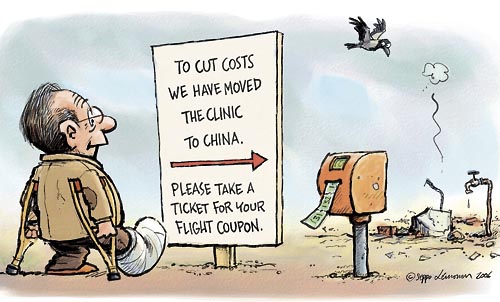
As a medical doctor, I read with concern claims by the opposition that rising health costs are the fault of "government mismanagement". Even more worrying were promises by the opposition to provide cheaper medical care (with one politician reminiscing of low healthcare costs in the 70s and 80s), with plans such a welfare scheme put forward by some parties, as if this were an end-all solution.


The reality is that healthcare is getting exponentially more expensive, by processes beyond the control of any government. The “cheap and easy” gains in health outcomes, such as vaccinations and sanitation, have been already been achieved. With demographic shifts reflecting those of first world countries, Singapore would soon be facing increasingly complex healthcare issues that require new, and often expensive, solutions. These would include an ageing population, with people living longer and developing more illnesses associated with old age (such as dementia, cancer and arthritis). Recent economic analyses from the US have demonstrated that any cost-saving from addressing preventable illnesses will be offset by these unavoidable “diseases of old age”.


Rapid advances in technology also mean that medical care today is a far cry from medical care from yesteryear (especially from the "good old 70s"). We have a larger number of more powerful drugs to treat conditions, many of which are being detected with more sophisticated tests. Technology has revolutionized medical practice, such as fibre-optic imaging in keyhole surgery. However, all of these advancements involve significant R&D costs, into the millions of dollars, which are then transferred to the end-users. By positioning ourselves as a medical hub, Singaporeans effectively now have access to these latest developments. However, if we want to continue to enjoy the latest pharmaceuticals or the most advanced imaging and surgical techniques, we will need to face the burgeoning costs associated with them.


What this means, is that healthcare is becoming more expensive at a rate never seen before, bringing the issue of healthcare costs to the forefront in many political debates around the world (the most recent, and perhaps significant, are the healthcare reforms in the USA). The best minds from around the world have sought a solution, but no easy answer has yet been found. Ultimately, the costs have to be borne by someone – in Australia and the UK, the governments have borne the costs through a welfare system. However, this is translated to significantly higher taxes for the people (close to 50% for some categories!) Even then, these governments are frantically searching for a way to curb the ballooning healthcare expenditure that is pushing the countries deeper into debt (as a friend of mine says – health care expenditure is basically a black hole). On the other hand, the USA has attempted to use a free market approach in an attempt to drive healthcare costs down via competition. Unfortunately, this has backfired for a number of reasons, leading to even basic healthcare being out of reach of a significant proportion of the population.


We should thus take any blanket promise of lower healthcare costs with a grain of salt, being aware that there is no simple answer to this complex issue. As the election draws close and more promises are being made, we should be wary of such utopian offers, realizing that there is no magic bullet to ease the pain of rising medical costs.


My 2 Cents, on probably the only topic I'm familiar with.

Sing Chee

Wednesday, 29 April 2009

On Swine Flus, SARS and perspective

This article from The Age pretty much sums some of the things going through my mind as people squeal in fear from the possibility of a pandemic from the H1N1 flu outbreak that will kill us all:

http://www.theage.com.au/opinion/fears-distorting-reality-20090429-ancz.html

Some extracts:
...why do the deaths of only some people from obscure diseases cause us to panic? And how can we be so unfeeling when we have the power to save the lives of millions by relatively simple, inexpensive precautions and treatments?....

...it seems that only when we perceive that infectious diseases threaten "people like us" do we respond with real urgency. The millions killed by TB, AIDS, malaria and other mass killers are doomed to fit the stereotype of people who live and die like that. We can accept it as the way of the world. Aboriginal Australians are just as much victims of the indifference that flows from such stereotyping.

In all reality, we only have 7 confirmed deaths from the Swine Flu (based on WHO analyses - Mexican databases aren't exactly stellar), in a country that is known for its gross inequities and dodgy standards of health and living. In contrast, the normal flu kills 250-500,000 people a year, of which 2000 are in Australia. Yet, all of the sudden, we have the leaders of the known world speaking up and declaring that they will spare no expense to contain this outbreak.

I admit the need for an effective public health response, and even acknowledge that there is more to gain from stoking people's fears and insecurities, hence keeping them on the alert, as compared to calming them. It's good to take appropriate measures at disease containment, for epidimiological reasons, but probably more so for political ones (this is already turning into opportunities to score political points if you read the news).

However, despite all the fearmongering about it being the "next big pandemic" and how we are "overdue for a massive outbreak"that "threatens the existence of humanity", in all likelihood this H1N1 virus thing is going to become something of the past, just as SARS did. Does anyone remember the HK flu from the 1960s that killed over a million people worldwide-no? In addition, the world of international communications and public health is incredibly different from what it was in the century of the last pandemic. Just google something like "Developments/achievements in the last 50-100 years" and you'll see what I mean (this includes the internet btw).

And so I come back to my original point - lots of fearmongering and scares at "possibilities" that are in reality mere shadows, revealing a distinct lack of perspective on disease and illness. This is in stark contrast to our ignorance at the daily epidemics and massive numbers of deaths in poorer nations around us. I believe these events do something more than threaten the health of us all - they reveal the hypocrisy and lack of perspective in our lives, how we spend with reckless abandon at anything that immediately threatens our welfare, but live in gleeful ignorance what happens beyond our own world (I'm just as much guilty of this). I cannot help but think about God's anger - not expressed through disease as a punishment, but against us, for our indignancy, and our love for evil, not good.

PS: For those who are freaked out by the WHO near declaration of a pandemic - look up the definition first, see see how vague it is. The only thing that separates a "pandemic" from something like the normal flu, is the fact that it's new to populations.

Saturday, 25 October 2008

Public ethics - a messy business

I've just completed a 3 day course on HIV prevention amongst sex workers, IV drug users, and men who have sex with men - and it's given me a lot to think about - in particular on the issue of legislation.

Let's take, for example, IV drug use. No government would be "proud" of having IV drug users around, and it is universally regarded as an undesirable practice. However, evidence has demonstrated complete prohibition of IV drug use doesn't really work that well, and has the downstream effects of causing the social marginalization and isolation that leads to high -risk behavioral patterns in that population. Services that would actually help these drug users cannot function effectively, as their target population is essentially underground, scattered, and fragmented.

On the other hand, by legalizing drug use, as in Victoria, we give organisations the opportunities to gather and target this particular population, providing ready access to support programmes and services that not only minimise the harm of IV drug use, but also facilatate their entry into rehabilitation programmes.

This approach presupposes a particular interaction between LAW and MORALITY. It suggests that the legal acceptance of a particular behavior does not necessary correlate with a moral acceptance of that same behavior. The corollary of that is that our moral convictions does not necessarily need translate into a corresponding legal stance on the issue.

This, obviously, flies in the face of what so many of us assume about the nature of legislation, and the role of our Christian values in the interaction with greater society. It did for me, and has now led me to rethink and reflect on my own ethical system, and how a public health physician (an area I'm working towards) engages in policy formation that affects an entire non-Christian community. SHOULD the law reflect and ENFORCE morality by force? And on what basis can we actually enforce a SPECIFIC brand of morality - religious or not (eg: why don't we take pedophilia off the criminal code)?

These are difficult issues, issues that have been around since the Church started getting involved in Roman politics. But they are also crucial issues worth reflecting on. I'll post more as I sort out my thoughts ;)

Tuesday, 30 September 2008

Unhealthy debt


I'm sure the majority of us have heard something about the Wall Street crash, with the closure (and near bankcruptcy) of several major US banks and insurance companies (eg: AIG, or AIA for those from SG). If you haven't, here's a 30 second summary: basically, US banks and companies were using debt to create more debt. Kind of like borrowing money from 1 person to buy something from another person - just on a global, massive financial scale. Now the bubble has burst, and all the bad debt has caught up with these institutions - and overnight, people with investments/savings with these institutions have seen their life savings disappear. People stop buying, US stops importing, and other countries stop exporting - and the economy grinds to a halt (I know the economists will tear me up for this oversimplification!).

But why bother with this? Those of us who haven't been taking risks with investments aren't affected, right? Even more so for those of us in the field of health care - we'll always have jobs, so as long as we don't overspend and make risky investments, we don't need to bother, right?

Wrong.

The WHO definition of health is as follows : "health is a state of complete physical, mental and social [and spiritual!] wellbeing, and not merely the absence of disease or infirmity" The corollary of that definition is that "anything that affects physical, mental and social [and spiritual] wellbeing affects health".

So what?


As health workers in a wide variety of capacities, we have to recognise that the issues we deal with are not entities existing in a vacuum that appear to the beat of some biostatistical value, but are often presentations of wide socio-economic issues.

In the case of the recent Wall Street meltdown, we have to stop ourselves from compartmentalising it into an "economic issue" - instead, we have to recognise that this will, in the great interconnectedness of society, eventually translate into health issues. The 1978 declaration of Alma Ata states: "Economic and social development, based on a New International Economic Order, is of basic importance to the fullest attainment of health for all".

The "illnesses" seen in the market place and society will more often than not translate into the "illnesses" seen in the consultation room, the pharmacy, the counselling rooms and the dental clinics. With a recession hitting the streets and people losing their savings and financial security, it would be not unexpected to see changes in the burden of diseases within society. We would be looking at remergence of infectious diseases as people begin moving to more cramped accomodations with poorer sanitation. There may be rising rates of depression, and possibly alcohol abuse and substance abuse (with relevant medical consequences) as a means of emotional anesthesia. Financial stressors could lead to relationship breakdown and domestic violence, with consequences for the long term health outcomes for members of those families. Eating a healthy and balanced diet may be replaced by settling for whatever was on special on the supermarket, more often than not something less than ideal, nutrition wise. A global recession is more than an "economic issue" - it is fairly and truly a health issue as well.

As health workers - doctor, nurse, dentist, pastor, phamacist, counsellor, physiotherapist, dietician, OT, etc - we have been tasked by God to engage with and contribute to the health of populations. It is only by looking beyond our textbooks and our own working space, to engage with the emerging challenges to the health of the people, that we can truly fulfill the task God has laid before us.