Showing posts with label ministry. Show all posts

Saturday, 3 October 2009

This is why we fight

In recent times, there have been some frustrating complications with church relationships and all, leaving me a bit frustrated and concerned. That same mood was carried with me into the Rosie's street ministry today, with me almost having to half drag myself out in the cold to serve the streeties.

However, during the night, I was brought back to reality, when one of our team members recounted how someone had been suicidal. She subsequently just sat and heard his story, prayed with him, and gave him a referral to LifeLine for support. After that, he said, in his own words, "This was the first time I've felt part of something".

At that point I realised - we get caught up in the details of life, in our frustrations and annoyances. We lose sleep over things that don't go our way, and our preoccupation is so often our struggle with life.

Yet, at the end of the day, we fight the good fight, not to put up a brave front to impress, or to polish our lives to sparkling perfection. We are fighting, contending, struggling for something bigger, greater, and beyond our own narrow little lives. It is the least of these that we are to struggle for: for the lives that Gods wants to touch and heal, for the broken people that He wants to comfort. We are fighting for the gospel, and for the ones that God loves.

This is why we fight; and believe it or not, God is on our side we are fighting on God's side.

Friday, 2 October 2009

Sad news - but inevitable?

I just received this mail from FORGE Australia:

For the last twelve years, Forge has sought to serve the Australian church by inspiring and training leaders to engage the first world as a mission field. We have had the privilege of working with many individuals and churches, helping catalyze missional initiatives and challenging the ecclesial status quo. Through God’s graces, we have seen significant shifts in the mindsets of Australian Christian leaders and for this rich and colorful journey, we are eternally grateful.

More recently, over the last two years we have been involved in a process of organizational reflection and future planning, seeking to identify what our contribution could be to the Australian church in the years ahead. After some long conversations and considered analysis of our position, we believe that the best way forward is to scale back all of our organizational operations for the foreseeable future."

As someone whose faith has benefited richly from the FORGE ministry, I'm really sad to hear this. I have been inspired, challenged and humbled by the many faithful members of FORGE. Seeing their zeal for missions in the West has rekindled a new flame and passion within my own heart for my neighbours and friends.

It is ironic, that the end the of the day, their basis for existence is to some extent the cause of their closure. In particular, they write:

Our current decentralized organizational structure has made it difficult to move ahead cohesively. The challenges associated with transitioning Forge to be an effective training organisation for the new context proved too costly.

FORGE has always pushed for a return to "Acts-style" churches, without the central administration and structure seen in "traditional churches", but rather an organic approach to church life. Thus, it doesn't come as a surprise that as FORGE grew, their commitment to "organic" administration meant that they did not have the administrative structure to support that growth.

While I'm sad to see FORGE Australia go, I think there's a great lesson in this - that at the end it's not all about "returning back to the good ol' days", it's about reaching people with the Gospel for the glory of God - and faithfully using whatever is available for those ends - even if they involve elaborate hierachies ;).

Sunday, 19 July 2009

Emerging Churches - More Wesleyan than the Methodists?

In recent times I've had the opportunity to attend a FORGE conference and get my hands on some material by Hirsch and Frost, and essentially get a bit more up to date with the whole "emerging church" movement.

Much ink has been spilled over reservations about the whole movement, particularly over their interactions with more "traditional" mainline churches. I share the sentiments of many others (Glen has written some excellent comments here), feeling that they have many good things to offer, but do often come across as being a bit arrogant in the simplistic neglect of tradition. Nonetheless, I'm inspired by their commitment to serious discipleship (something which has definitely lapsed in many churches) as well as their intense missional focus, particularly in their service to the poor.

No doubt there are some questionable characters in the movement (I'm not a fan of McLaren), but amongst the more balanced people, I've been interested to find how much they have in common with the spirit of Wesleyanism. For example, in The Shaping of Things to Come, Hirsch and Frost write:

...what the church needs to find its way out of the situation it's in at the beginning of the 21st Century, is not more faddish theories about how to grow the church without fundamentally reforming structures. What the church needs is a revolutionary new approach.

They advocate that the church need to restructure itself around the concept of mission (rather than worship, which is very prevalent today), on the basis that:

...the missional church represents God in the encounter between God and human culture....it is a visible manifestation of how the Good News of Jesus Christ is present in human life and transforms human culture to reflect more faithfully God's intentions for creation.

In other words, our construct of ministry and mission should not and must not be centered within what we call "Church". "Ministry" is not just about ushering, leading worship or playing the piano - it is also very much (and more so!) about MISSION - our engagement and interaction with the world the other 6 days of the week. For many, it is thus lamentable that church structures and organisations are so church-centered - we encourage people to attend prayer meets, cell groups, sunday schools, choirs, courses, seminars, workshops, meetings, etc, hence effectively taking people OUT of their community and keeping them IN the Church.

Hirsch and Frost see this church centered functioning as a logical outcome of "traditional" ways of church organisation and institutionalisation, and hence call for a radical restructuring of our churches, at points calling us to return to "primitive" Christianity.

What struck me was how similar this sounded to the Wesleys as they began their ministry. Chilcote, in The Wesleyan Tradition, comments on the Wesleys' beliefs:

The church of England in the Wesleys' day was an institution in need of repair...It had become distant from and irrelevant to the world it was called to serve during a time of tremendous change. Its forms and its structures had become so inflexible and devoid of life that the weight of its "institutionalism" was quenching the Spirit, suffocating the life of God's people....It needed to rediscover itself and reclaim its identity as God's agent of love in the world. The Wesleys believed that God raised them up to resuscitate the church.

Commenting on the Wesleys' understanding of the function of the church, he says:

Their ecclesiology (understanding of the church), therefore, was essentially missiological (formed around mission)... All of their energy was directed toward the empowerment of Christ's fiathful disciples in ministry to God's world. Indeed, they all viewed evangelism and mission...as the reason for their existence.

Given that the Methodist Church today has become more well known for being "Methodical" (in terms of beauracracy and red tape, rather than in the pursuit of holiness), I can't help but wonder whether the much maligned "Emerging Church" movement actually better embodies what it means to be a Methodist than many Methodists, by demonstrating a stronger passion for a more missional, discipleship oriented, and contextual approach to church life.

However, perhaps more importantly, how do we as a church rediscover what it means to be "missional" - what sacrifices and pains will it take, and will we take them?

Wednesday, 15 July 2009

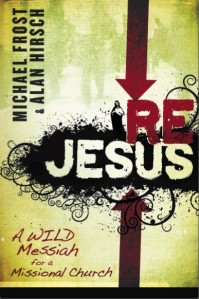
Review for "ReJesus - A wild messiah for a missional Church' by Hirsch and Frost


Hirsch and Frost are concerned only with 1 word - J.E.S.U.S. Call them what you may, but their premise is simple: the modern western church has strayed far from the teachings and values that its founder Jesus Christ embodied - he has been domesticated to fit our agenda. Echoing characters such as Barth, they declare that Christ must remain central in the faith, as nothing can be known/felt/done apart from Christ himself. To make their point, they go through 7 chapters that discuss (in order): how Jesus impacts theology/missiology/ecclesiology, how he impacts individuals and how he impacts communities. They explore the false images we've made of Jesus, and how the Shema provides a holistic model for discipleship in the form of monotheistic ethics. They go on to discuss the importance of intersecting orthodoxy, orthopraxy and orthopathy, and finish off with a discussion on ecclessiology (which is admittedly very functional).

In general I'm quite wary of these kind of books (that proclaim that 'everyone is wrong and we just need to get back to basics'), as they often have a blaise disregard for the value of tradition and history. The authors constantly affirm the value of tradition, thankfully, but provide few insights into how this may be reinterpreted in the context of a renewed Christologic focus, so as to avoid throwing the baby out with the bathwater.

This, however, does not hurt their main, and very timely message - that we need to rescue the gospels (and Christology) from the dungeons, and place them and their central figure back at the center of our existence as the church. In doing this, they rightly argue, the church will rediscover what it means to be "missional", in every sense of the word, as they embody the values of their Lord. Rather than the tame, gentle, huggable, nice lady-like Jesus of our paintings, they present a challenging, radical, loving, confrontational, non-conformist and passionate Jesus. This they do very well, with a good mix of anecdote and story to add some personal flavor to their writings, leaving one with the challenge to read the Gospels more intently, keeping our eyes and heart open to the person they testify to.

Ironically, the book is short on the very material it seeks to promote - Christology. There's plenty of discussion around the impact that Christology would have, but not much exploration of the man himself - but perhaps that is too much of an ask for a book only 200 pages long! In addition, attempts at serious theological reflection (such as the section on ecclesiology) are pretty flimsy, but then again, this book is more about the importance of prioritising Christology than an actual discussion of the subjects themselves.

All in all, ReJesus is a good read that will no doubt stir the reader to rethink and reflect on putting the Christ back into being Christian, and learn to read the gospels more robustly, leading to a reinterpretation of the identity of the church. In a sense, what Barth did as a theologian, Hirsch and Frost are doing as missionaries. It gets pretty draggy and repetitive at points, but remains a great starting point for discussion on ministry.

Tuesday, 23 December 2008

The Demise of Theology

I've recently been really thinking about whether theology as a field of study has any more place within the contemporary church, and felt this this comment by Webster, in Barth (2000) hit the nail on the head:


" Barth worked in a religious culture in which - possibly for the last time in Protestant history - sophisticated theological ideas were accorded great prestige, even when they were repudiated. The institution and forms of the Christian life which nurtured such a massive project as the Church Dogmatics scarcely exist, or exist only in somewhat embattled forms"


Looking around me, I can't help but feel the same way. The modern church is characterised by an almost anti-intellectualism, where proper thought and reflection is marginalised in preference for "life application".

We no longer seek to sharpen our understanding of the faith, making sure that proper action is guided by proper thought. Instead, so many approach the Christian faith as if it were some manual for life, giving point by point direction on how to do this or that. Whilst I cannot deny the need for practical theology, I cannot help feeling that we have, in doing so, "tamed" the Word of God, thinking that it can be bent to our own purposes, limited by our needs.

(For those wondering, the Church Dogmatics is a massive multivolume work by the theologian Karl Barth, who is regarded as one of the finest theologians of the 20th Century, in the company of Calvin and Augustine. This work has shaped alot of modern theological reflection, particularly Christology)