Showing posts with label christian. Show all posts

Sunday, 26 July 2015

Why My Son Was Baptised: Part 2

Having established the biblical and traditional foundations for affirming the efficacy of Baptism, we next explore the question of "what is it efficacious for"?

Starting again from scripture and examining the texts previously referenced in Part I, we find that a parallel is drawn between baptism and circumcision. Circumcision, an act initiating an individual into God's covenant community in the Old Testament, is aligned with the practice of baptism in the New Testament (Col 2: 11-12). Although the scriptures remain firm on the centrality of faith and obedience in bringing meaning to the act of circumcision (1 Cor 7: 19), they do not divorce inward faith from the external act. Utilizing this framework, we come to an understanding of baptism that underscores it's centrality in the Church's mission and life - that through this act God incorporates an individual into the greater body of Christ (1 Cor 12:13), God's new covenant community established in light of the death and resurrection of Jesus Christ. 

St. Athanasius, in his response to the Arian controversy, relied heavily on this understanding of baptism to defend the co-divinity of the Father, Son and Holy Spirit:
The faith in the Trinity transmitted to us is the only one, and it unites us with God, and whoever takes something away from the Trinity and baptizes in the name of the Father, or in the Son alone, or into the Father and the Son without the Spirit, receives nothing, but those being baptized and he imagines himself to be giving baptism remain in vanity and unconsecrated, because the Mystery is accomplished in the name of the Trinity: so that whoever separates the Son from the Father or reduces the Spirit to a creature has neither the Son nor the Father but is an atheist, worse than an unbeliever, and anything but a Christian.
Implicit within his argument is the assumption that the efficacy of baptism is driven by the power of the Trinitarian God, subsuming the individual into the divine life of the Trinity and hence into the Church as Christ's body. Thus, a failure to appropriately recognize the effector of this act leads to a baptism that is inefficacious for true Christian conversion, leaving nothing accomplished in the unseen realm and keeping the individual separate from true union with the body of Christ. 

This close relationship between a sacramental understanding of baptism and the Church may be readily observed today: in communities where a robust and well-developed eccelesiology is articulated, a  deeply sacramental understanding of baptism continues to be practiced (e.g. Anglicanism, Roman Catholicism, Lutheranism), with a recognition of the integral part it plays in Christian faith and practice. Likewise, Christian communities with a less established ecclesiology typically downplay the significance of baptism. As unfortunate as it is, this latter pattern has become pervasive in protestantism, driven by an individualism which has been characteristic of a post-modern worldview emphasizing individual belief and opinion against corporate confession and belief.

In summary, an examination of scripture as well as tradition suggests the following regarding baptism:
  1. Baptism is more than a "symbolic" act of an inward conversion. Rather, baptism performed in the context of faith, is an act demanded by God of the Church, in which He effects a change in the life of the recipient.
  2. The effect of baptism is tied closely to the believer's participation in the life of the Church; God has made it normative that all who come to faith are to be baptized into the body of Christ (However, normativity does not necessarily translate into exclusivity; someone who confesses faith in Christ and dies before being baptised will still be saved).

Saturday, 3 October 2009

This is why we fight

In recent times, there have been some frustrating complications with church relationships and all, leaving me a bit frustrated and concerned. That same mood was carried with me into the Rosie's street ministry today, with me almost having to half drag myself out in the cold to serve the streeties.

However, during the night, I was brought back to reality, when one of our team members recounted how someone had been suicidal. She subsequently just sat and heard his story, prayed with him, and gave him a referral to LifeLine for support. After that, he said, in his own words, "This was the first time I've felt part of something".

At that point I realised - we get caught up in the details of life, in our frustrations and annoyances. We lose sleep over things that don't go our way, and our preoccupation is so often our struggle with life.

Yet, at the end of the day, we fight the good fight, not to put up a brave front to impress, or to polish our lives to sparkling perfection. We are fighting, contending, struggling for something bigger, greater, and beyond our own narrow little lives. It is the least of these that we are to struggle for: for the lives that Gods wants to touch and heal, for the broken people that He wants to comfort. We are fighting for the gospel, and for the ones that God loves.

This is why we fight; and believe it or not, God is on our side we are fighting on God's side.

Sunday, 19 July 2009

Emerging Churches - More Wesleyan than the Methodists?

In recent times I've had the opportunity to attend a FORGE conference and get my hands on some material by Hirsch and Frost, and essentially get a bit more up to date with the whole "emerging church" movement.

Much ink has been spilled over reservations about the whole movement, particularly over their interactions with more "traditional" mainline churches. I share the sentiments of many others (Glen has written some excellent comments here), feeling that they have many good things to offer, but do often come across as being a bit arrogant in the simplistic neglect of tradition. Nonetheless, I'm inspired by their commitment to serious discipleship (something which has definitely lapsed in many churches) as well as their intense missional focus, particularly in their service to the poor.

No doubt there are some questionable characters in the movement (I'm not a fan of McLaren), but amongst the more balanced people, I've been interested to find how much they have in common with the spirit of Wesleyanism. For example, in The Shaping of Things to Come, Hirsch and Frost write:

...what the church needs to find its way out of the situation it's in at the beginning of the 21st Century, is not more faddish theories about how to grow the church without fundamentally reforming structures. What the church needs is a revolutionary new approach.

They advocate that the church need to restructure itself around the concept of mission (rather than worship, which is very prevalent today), on the basis that:

...the missional church represents God in the encounter between God and human culture....it is a visible manifestation of how the Good News of Jesus Christ is present in human life and transforms human culture to reflect more faithfully God's intentions for creation.

In other words, our construct of ministry and mission should not and must not be centered within what we call "Church". "Ministry" is not just about ushering, leading worship or playing the piano - it is also very much (and more so!) about MISSION - our engagement and interaction with the world the other 6 days of the week. For many, it is thus lamentable that church structures and organisations are so church-centered - we encourage people to attend prayer meets, cell groups, sunday schools, choirs, courses, seminars, workshops, meetings, etc, hence effectively taking people OUT of their community and keeping them IN the Church.

Hirsch and Frost see this church centered functioning as a logical outcome of "traditional" ways of church organisation and institutionalisation, and hence call for a radical restructuring of our churches, at points calling us to return to "primitive" Christianity.

What struck me was how similar this sounded to the Wesleys as they began their ministry. Chilcote, in The Wesleyan Tradition, comments on the Wesleys' beliefs:

The church of England in the Wesleys' day was an institution in need of repair...It had become distant from and irrelevant to the world it was called to serve during a time of tremendous change. Its forms and its structures had become so inflexible and devoid of life that the weight of its "institutionalism" was quenching the Spirit, suffocating the life of God's people....It needed to rediscover itself and reclaim its identity as God's agent of love in the world. The Wesleys believed that God raised them up to resuscitate the church.

Commenting on the Wesleys' understanding of the function of the church, he says:

Their ecclesiology (understanding of the church), therefore, was essentially missiological (formed around mission)... All of their energy was directed toward the empowerment of Christ's fiathful disciples in ministry to God's world. Indeed, they all viewed evangelism and mission...as the reason for their existence.

Given that the Methodist Church today has become more well known for being "Methodical" (in terms of beauracracy and red tape, rather than in the pursuit of holiness), I can't help but wonder whether the much maligned "Emerging Church" movement actually better embodies what it means to be a Methodist than many Methodists, by demonstrating a stronger passion for a more missional, discipleship oriented, and contextual approach to church life.

However, perhaps more importantly, how do we as a church rediscover what it means to be "missional" - what sacrifices and pains will it take, and will we take them?

Wednesday, 15 July 2009

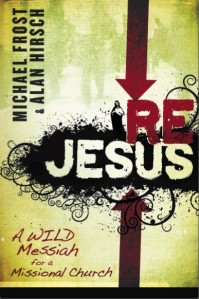
Review for "ReJesus - A wild messiah for a missional Church' by Hirsch and Frost


Hirsch and Frost are concerned only with 1 word - J.E.S.U.S. Call them what you may, but their premise is simple: the modern western church has strayed far from the teachings and values that its founder Jesus Christ embodied - he has been domesticated to fit our agenda. Echoing characters such as Barth, they declare that Christ must remain central in the faith, as nothing can be known/felt/done apart from Christ himself. To make their point, they go through 7 chapters that discuss (in order): how Jesus impacts theology/missiology/ecclesiology, how he impacts individuals and how he impacts communities. They explore the false images we've made of Jesus, and how the Shema provides a holistic model for discipleship in the form of monotheistic ethics. They go on to discuss the importance of intersecting orthodoxy, orthopraxy and orthopathy, and finish off with a discussion on ecclessiology (which is admittedly very functional).

In general I'm quite wary of these kind of books (that proclaim that 'everyone is wrong and we just need to get back to basics'), as they often have a blaise disregard for the value of tradition and history. The authors constantly affirm the value of tradition, thankfully, but provide few insights into how this may be reinterpreted in the context of a renewed Christologic focus, so as to avoid throwing the baby out with the bathwater.

This, however, does not hurt their main, and very timely message - that we need to rescue the gospels (and Christology) from the dungeons, and place them and their central figure back at the center of our existence as the church. In doing this, they rightly argue, the church will rediscover what it means to be "missional", in every sense of the word, as they embody the values of their Lord. Rather than the tame, gentle, huggable, nice lady-like Jesus of our paintings, they present a challenging, radical, loving, confrontational, non-conformist and passionate Jesus. This they do very well, with a good mix of anecdote and story to add some personal flavor to their writings, leaving one with the challenge to read the Gospels more intently, keeping our eyes and heart open to the person they testify to.

Ironically, the book is short on the very material it seeks to promote - Christology. There's plenty of discussion around the impact that Christology would have, but not much exploration of the man himself - but perhaps that is too much of an ask for a book only 200 pages long! In addition, attempts at serious theological reflection (such as the section on ecclesiology) are pretty flimsy, but then again, this book is more about the importance of prioritising Christology than an actual discussion of the subjects themselves.

All in all, ReJesus is a good read that will no doubt stir the reader to rethink and reflect on putting the Christ back into being Christian, and learn to read the gospels more robustly, leading to a reinterpretation of the identity of the church. In a sense, what Barth did as a theologian, Hirsch and Frost are doing as missionaries. It gets pretty draggy and repetitive at points, but remains a great starting point for discussion on ministry.

Monday, 13 April 2009

Camps, Love and Couples


Our mid-year church camp's theme is "true love awaits", and as the name suggests, it's about "how to love". As one can guess, the promotion so far seems to suggest that while it is not exclusive to couples, it is significantly focused on these relationships.

Apart from the obvious theological issues of asking an anthropocentric question of "how do WE love", I have been wondering whether this is an insensitive and inappropriate theme for a combined church camp.

Within any church, including ours, there is a mixture of singles and couples, and I do wonder whether having a COMBINED camp that focuses on couple relationships does little more than to rub in the fact that the singles are single. Yes they have said that the camp is not just for couples, but the promotional material seems to suggest that singles are more of a "not uninvited" group.

Perhaps it's just been the way it's been promoted, and the actual camp isn't about about couple relationships. But looking at the way it's been going, it seems like it's going to be more segregating than unifying.

Monday, 30 March 2009

The Great Divorce

OK, so maybe it isn't as great a divorce as I make it out to be, but it's still there. Anyway, on to my point:

People in our church have recently been talking alot about change. I'm not sure if it's just some pseudo-Obama fever, or just plain frustration with what's been essential stagnation over the last few years, but the sentiment is there nonetheless.

We have a new pastor, who goes on about how she's going to bring big change. We have a chairperson talking about how change is going to happen in the church this year, and the small group coordinator talks about how change is good. Our sister service, the chinese congregation, is also now shifting their service time to the arvo. (the list goes on)

Whilst I'm not against change, what I do get concerned with is blind change. Yes there may be a need for a move out of a particular situation, and sometimes the move brings some fresh air. However, more often than not, this move is done on the basis of a "good idea" (or something gathered from an experience/book somewhere). There is a prevailing experimental attitude that goes: "this isn't working, so let's try something else and see if it works".

I find it fascinating that the underlying assumptions driving this attitude is rooted in a pseudo-scientific/modernist concept: That there is something that works/is true, and our duty is to explore and experiment until we find out what it is (in contrast to perhaps pre-modern approaches where pure tradition, rather than pragmatism, was the aim of the game).

At the same time, however, Church ministries ignore the other elements of this underlying methodology: namely the concept that it is the combined progress of a body of people that counts. In other words - Churches/ministers tend to want to do 'research' on their own, without the necessary engagement with what others have done elsewhere/before them.

A classic example is the relationships between adolescent behavior and knowledge. Research into adolescent behavior over the last few decades has demonstrated a very weak link between knowledge and practice - ie: for the adolescent, knowledge is not power. In a health setting, it means that providing education on safe sexual practices, safe eating, safe driving, etc, will NOT produce significant behavioral change.

It's not difficult to see how this can easily apply to the church setting as well - we enjoy going on from the pulpit and sunday school classes that youths should read the scriptures and the bibles for their spiritual growth, etc etc - and we all know how that turns out (anecdotally, it would seem that the average youth has immense problem sticking to a disciplined, regimented schedule of daily scripture readings). Recognising that the provision of information does not necessarily lead to behavioral change within this population would lead one to conclude that many of our current methodologies do not work too well.

Whilst we recognise that God is the one who "makes the seeds grow", we also have to recognise that in our ministries, we essentially stand on the shoulders of giants. Where would we be if we did not recognise the contributions of Calvin and Luther to our understandings of salvation, or Tertullian and Augustine to the language of the faith? It is perhaps time to recognise that God has not left us to grasp at straws in the dark, but has made available to us a wealth of resources and tools that enable us to be more effective at discipling the people of the nations. It is perhaps time to heal the great divorce between ministry and research.

(Maybe it's time for Pastors to get UpToDate subscriptions :P jkjk)

Monday, 6 October 2008

Any "objective" historians out there?

I'm currently working on a presentation on the 19th Century Cane Ridge revival in North America, in the form of a "role play". I chose to write as a skeptical young journalist, more interested in trashing the Christian faith than anything else. Here's a snippet:

Even the much touted Bible, the source of all Christian "revelation", is really full of sin, immorality, evil and plain silliness. If we read it uninfluenced by the holy banter from the pulpit, we will surely agree with Thomas Paine that “it is more consistent that we call [the bible] the word of a demon than the word of God".

It's really quite interesting to be writing from the other side of the fence. I think it really illustrates Cairn's discussion on the nature of history - that there are scientific (factual) elements, philosophical (interpretative) elements, and artistic (presentation) elements. In this case, I had to report on the factual events of the Cane Ridge revival, interpreting them as a skeptic, and present them in a journalistic format (I fail at the last, I reckon).

It's a useful reflection on the nature of all forms of reporting - that there will always be a subjective, interpretative element to things we say and do. It is much better, I propose, to recognise our inherent biasness and account for them, than to pretend that we are capable of "objective" thought, free from the influence of the world in which we live.